Episode Transcript
[00:00:00] Speaker A: What if the secret to success is not talent or ambition, but just overcoming your fears,
[00:00:07] Speaker B: ramping up your business?
[00:00:08] Speaker A: The time is near. You've given it hard. Now get it in gear.
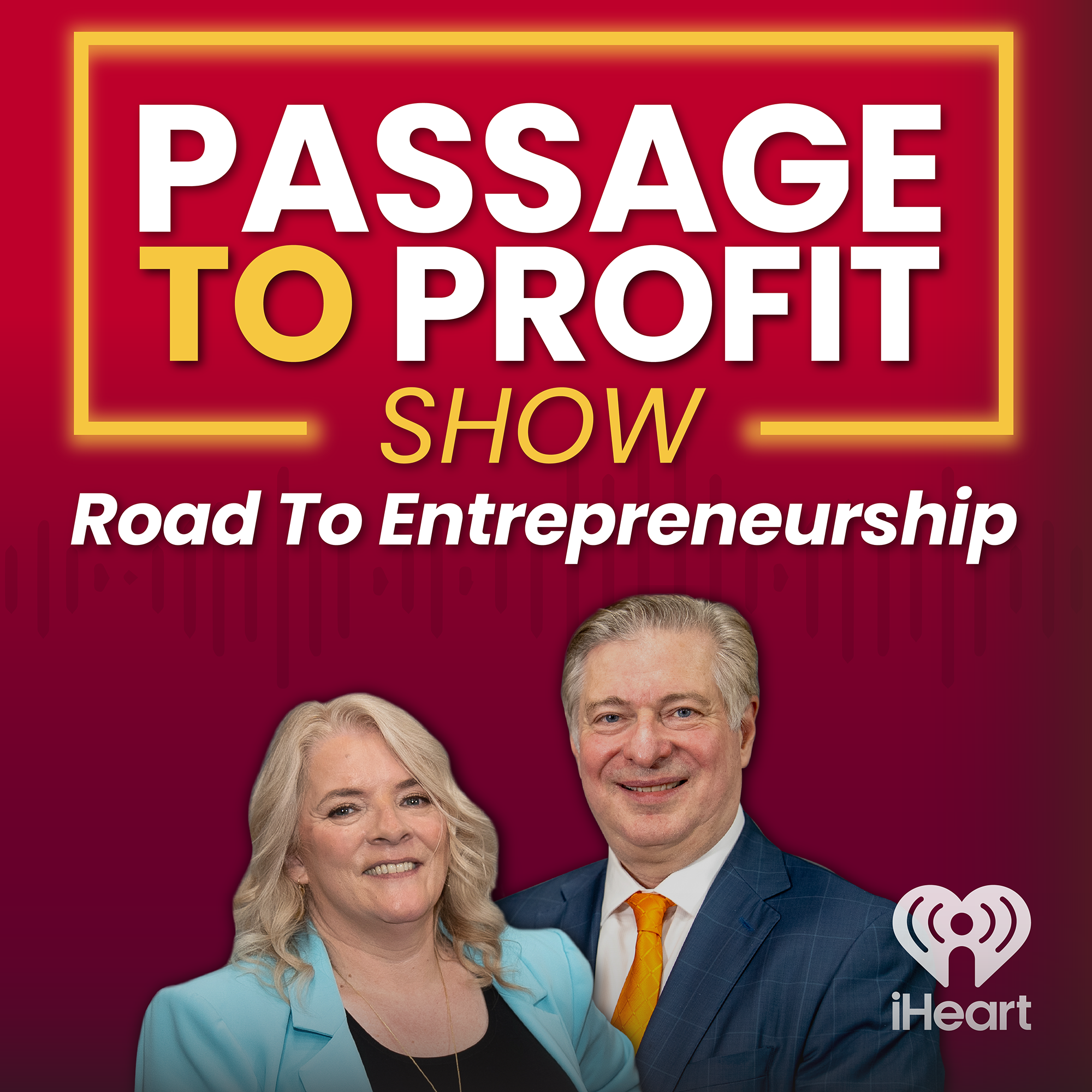
[00:00:13] Speaker B: It's Passage to Profit with Richard and Elizabeth Gearhart.
[00:00:18] Speaker A: I'm Richard Gearhart.
[00:00:19] Speaker C: I'm Elizabeth Gearhart, and we're your hosts.
[00:00:21] Speaker A: Welcome to the Passage to Profit show, the Road to Entrepreneurship podcast. Elizabeth, what's new with you?
[00:00:28] Speaker C: A lot of things. Well, I was just thinking about how much fun it is to go into New York because my niece is coming with her daughter, and I'm trying to put together an itinerary, and instead of trying to find things to do, I'm trying to cut out the stuff that we won't have time for. There's so much fun things to do in New York.
[00:00:44] Speaker A: I know it's an amazing city, and I'm looking forward to their visit. I hope that you have some interesting things planned for us that we haven't done before.
[00:00:52] Speaker C: Well, I don't know about that.
Well, you haven't done rise yet.
[00:00:55] Speaker A: I haven't done rise yet. So, speaking of young people and your niece's daughter, what's the one thing that everyone should know how to do before the age of 18?
[00:01:06] Speaker C: I think balance your checkbook.
[00:01:07] Speaker A: I would say number two on that is changing a car tire.
[00:01:11] Speaker C: I don't think so.
[00:01:11] Speaker A: You don't think?
[00:01:12] Speaker C: I think I've never changed a tire in my life.
[00:01:14] Speaker D: Well, that's because.
[00:01:16] Speaker A: That's because I change the car tires. Right, exactly. But, you know, if you're out in the middle of nowhere and you need to change a flat tire, you know how to do it. I think it can be a pretty dangerous situation.
[00:01:29] Speaker C: So, anyway, so one thing we're really enjoying this summer is our screen porch. We decided we had to have a house with a screen porch, and it's been pouring down rain a lot in New Jersey, but we can still sit outside and enjoy things after dinner on this porch.
[00:01:44] Speaker A: Yeah. So the nice thing is, is you don't get any bugs, and we happen to be pretty close to one of the great swamps, so I bet many of our listeners did not know that New Jersey has swamps, but we have a big one fairly close to our house, and of course, it's loaded with bugs, so the porch provides a super great shelter for that. So, speaking of kids, again, I want to go back to your niece's daughter. What's the one food that you hated as a kid?
[00:02:11] Speaker C: Liver. Still hate it.
[00:02:13] Speaker A: Liver wasn't so bad the way My mom cooked it. I mean, she cooked it with onions, she put it in a sauce. I thought it tasted okay.
[00:02:19] Speaker C: The smell of it cooking made me want to vomit.
[00:02:22] Speaker A: Well, I had, I had the same reaction to creamed eggs.
[00:02:25] Speaker C: What are creamed eggs?
[00:02:27] Speaker A: I had these creamed eggs when I was in daycare. They, I think they'd like open them out of a can and poured them in and into my plate and heated it up and it was just terrible. So ever since then, I have not liked eggs except for, you know, scrambled eggs. Okay, well, anyway, welcome to the show everybody. Today we have John La Puma. He's a physician, chef, regenerative farmer. I don't know if that means he regenerates, but I guess we'll have to ask him and find out. And he's also a two time New York Times best selling author. And he reveals why just 17 minutes outdoors every day could help you reset your biology.
[00:03:07] Speaker C: And after I looked at your website, I went and sat outside for 20 minutes. Not on the porch, on the deck.
[00:03:13] Speaker A: On the deck in the sun.
[00:03:14] Speaker C: And then we have Michael Greenberg, founder of Third Brain Digital operations.
And so many businesses are not doing AI right. And he's got the answer for that. So I can hardly wait to hear what he has to say.
[00:03:27] Speaker A: I can hardly wait to hear.
[00:03:29] Speaker C: And then Bill Treylor, owner of Rank Magic. In this era of AI, is your website still important? Well, it is more important than ever. Is Google still important? Heck yeah. So let's hear how Bill helps people get found. And coming up later on, it's Noah's retrospective.
[00:03:46] Speaker A: And on top of that, we'll be exploring secrets of our entrepreneurs minds later in the show. But first, it's time for your new business journey. We'd like to ask our panel, when you look back, what was the one decision or moment that most changed the trajectory of your career and what did it cost you to make that decision? Dr. LiPuma, welcome to the show. What was the one decision that you made that changed the trajectory of your career?
[00:04:10] Speaker D: I would say there have been five or ten of them. But the one that comes to mind most easily is when I was a medical resident in Los Angeles, I accepted a relatively new general internal medicine fellowship at UCLA to become a general internist and specialist in general internal medicine.
Um, but there is this new fellowship at the University of Chicago, which I had not heard from in clinical medical ethics.
And that was a new field in medicine, a new field of formal study, and there weren't any other fellowships in the country. And I'd Just been able to publish a letter in the New England Journal of Medicine about an area in medical ethics. And I got a call from the program director named Mark Siegler, who said, john, we'd love you to be a fellow in our program and the first fellow in the country in this new fellowship. And I said, yes, sir, I'm going to come. But that meant I had to tell the people at UCLA I wasn't going to accept their fellowship. And they were not very happy about it because it was February and their fellowship was supposed to begin in July.
They filled the fellowship in July, and I'm sure someone else did a great job. But going to Chicago, hearing new ideas, hearing people who were interested in those new ideas, and learning medical ethics in a way that I was able to help patients and families was life changing for me. And I was grateful to have Mark Siegler as a mentor for many years.
[00:05:47] Speaker A: Well, that's amazing. Thank you for sharing. And it really was a fork in the road, so to speak, right? You had really kind of two different specialties that you had the option to pursue.
And did you take the road less traveled? I don't know, but it led you where you are today. So, Michael, welcome to the show. And tell us, what was the one decision that most changed the trajectory of your business?
[00:06:10] Speaker E: I think I'd have to say when I decided to start this current business, Third Brain. I had sold two businesses prior and went to work for somebody much, much more successful than me and spent about a year there before I realized, you know what, I really should be out on my own. I want to be doing this again. And so I went and talked with my boss, now my mentor, and said, hey, you know, I want to take some of the work I did, turn it into my first case study and go start a business doing this for others.
And he said, great, get out there. And that turned into Third Brain.
[00:06:45] Speaker A: Well, that's a great story. It's so nice to have a supportive boss who's willing to just say, go out there and do it right, instead of, you've got this employment contract and, you know, you better stick with it. Right. So congratulations on that.
[00:07:00] Speaker E: They became my first customer as well, which made it a lot easier.
[00:07:03] Speaker A: Awesome. Bill. Bill Trelor, Good to see you again. Bill, welcome to the show. What was the one decision that you made that changed the trajectory of your business?
[00:07:12] Speaker F: Well, when I left the corporate world at age about 55, I was doing database development and support. And while we were waiting for my income to come back up to Normal. My wife, Blanche, who was a schoolteacher, decided to tutor kids with learning disabilities after school in our home.
I immediately realized, oh, she needs a website. So I learned how to design websites, and I made a website for her. And no sooner had I done that than I said to myself, what good is this thing if nobody knows about it? To go and look at it.
So I discovered SEO. This is about 25 years ago.
I learned SEO, I optimized the website, and it made a world of difference.
So I began to design small websites for other small businesses locally, optimizing them for good rankings in the search engines. And Google wasn't the biggest thing back then. It was altavista and Netscape and some others. But that was the decision that changed my life. And once I realized how much fun it was and that I seemed to have an affinity for it and was good at it, that was the decision that changed my life. And all I do now is SEO consulting.
[00:08:19] Speaker A: That's great. Thank you very much. And it's funny how those circumstances can really make a change, and it led you into a career of entrepreneurship. And so thank you for sharing that, Elizabeth.
[00:08:32] Speaker C: So we're on our third software update transition for Gearhart Law for our ERP system.
And I realized from the last two, especially the first one, though, that I kind of had to try to learn how developers think, how the other side thinks.
And I've been trying to figure that out. And I gotta tell you.
[00:08:52] Speaker A: You were able to figure that out?
[00:08:53] Speaker C: No, no. But I learned a lot, so I started focusing on that. And then when AI came into play, it's been a tremendous research assistant trying to figure out how can I communicate what I need with the developers and what are they gonna say back to me, and what's some language they'll understand if I wanna do this? And so I think that that has made. I'm hoping that this next transition will be a lot smoother. I've been freaking out all over everybody saying, we've got to do this, we got to do this.
[00:09:20] Speaker A: From your lips to God's ears, for sure.
I would say for myself, one change in trajectory was trying to become more of an educator rather than just a professional.
So I think that taking what I know and sharing it with other people, in the field of intellectual property especially, but also in entrepreneurism, has, I think, made me a more effective business partner. I think by educating people, you build trust. Building trust builds better relationships. So for me, that, I think has. Was sort of a significant understanding on my part and as sort of A significant insight, I guess. Thank you everybody for your contributions. Now it is time for Dr. Lipuma.
What if the reason you're exhausted, distracted and not sleeping well isn't stress? It could be the fact that you spend 93% of your life indoors. Dr. John LiPuma, a board certified physician, professionally trained chef, regenerative organic farmer, and two time New York Times best selling author, says modern indoor life may be quietly disrupting our biology. His prescription, just 17 minutes outdoors a day could help reset your sleep, focus, energy and health. Welcome to the show Dr. Lipuma. Really great to have you here. I know you've been out there in the media for a long time and you've had many opportunities to share your insights. Maybe you can tell us why 17 minutes a day outdoors is so important.
[00:10:56] Speaker D: 17 minutes is the minimum effective dose for changing your biology. We spend, as you said, 93% of our time indoors and just 7% outdoors. And that's not how we evolved as a species. Richard and Elizabeth we evolved outdoors, but just in a generation we've moved back indoors and we really haven't left. This became normal to have a screen centered indoor life in Covid where we were told that it was safer to be indoors, but it turns out that wasn't true and it's still not. It's actually safer to be outdoors and it gives us some of the biologic inputs that we need that we're missing when we spend nearly all of our time indoors. Spending nearly all of our time indoors is giving us bad sleep, it's giving us burnout, it's giving us brain fog, it's giving us belly fat that won't move, it's giving us problems with mood and focus and it is a changeable, fixable phenomenon. But many people don't realize, I think, that it's a hidden health problem that is only recent and that we can change with deliberate, intentional, focused time outdoors.
[00:12:06] Speaker C: Do you need to be moving during that time or does it count if you sit out on your deck reading a book?
[00:12:11] Speaker D: You know you don't need to be moving during that time. That some of this is based on what's called circadian biology or setting your body clock. About 50% of your genes only work optimally if they get the right signals for from your body clock. Many people don't even know about the body clock, but the things that set the body clock are primarily light. Intentional light at the right time for the right duration of time and preferably in the right location early in the morning and movement outdoors and eating are Also what are called zeitgebers, that's the fancy term for it, but those are the three things that set your body clock. So, no, you don't have to be moving, but if you combine the movement and outdoor light early in the morning, you get two signals to your brain that tell your body clock, I'm set for the day. I'm going to make melatonin tonight. I'm going to be alert, have a big cortisol boost in the morning and have it fade during the day. And at night when I'm asleep, I'm going to engage in deep sleep, which is when you repair muscle and rebuild bone and clean your brain in what's called the glymphatic system, which is a kind of a dishwasher cycle for your brain that takes out beta amyloid and tau, which are the proteins that accumulate during Alzheimer's disease.
[00:13:30] Speaker A: So does it matter what time of day you get your outdoor activity? If you're setting your circadian rhythms right, I guess it's preferable to do it early in the morning, maybe shortly after you get up.
[00:13:44] Speaker D: That's right, Richard. The optimal time when your retinal receptors, the back of your eye receptors, are most receptive to bright light is within an hour of waking. So if you can go outside, or if you don't have outside access, you can look through an open window, or if you don't have an open window access and you live in a city and you have a threshold or a balcony or a fire escape, the light works through your eyes. And if you're light, the light hits your eyes early in the morning, preferably within an hour of waking, without sunglasses and not through a window, it gives you that 25 to 50 times brighter signal you get outdoors from daylight so that your brain's body clock is set for the day. And when you're outdoors or you're looking through the window with the screen, or you're wherever you need to be to get that light, you're not looking at your device and you don't have a task list.
[00:14:40] Speaker A: I'm a believer in what you say because really just this summer I started getting. Getting up early and doing a little bit of exercise in the morning outdoors. We've had some beautiful mornings here in New Jersey with lots of sun, moderate temperatures, and Elizabeth can testify. I come back into the house and I say, it's a great morning. You should get out there and it's gorgeous. And it really starts my day off on the right foot.
[00:15:07] Speaker C: Well, it rings true for me, too. And I'm telling you, I'm gonna make this vow on this show right now. I am gonna start doing this every day, come rain or snow or whatever it is, because I think I know you're 100% right. Because when I was in college, what did I do? I got up, I took a shower, I went outside, I walked over to the dining hall, had breakfast, walked all over campus, right? So I got sun first thing in the morning. And I feel like my sleep and everything was a lot better back then. That's probably a part of it.
[00:15:38] Speaker D: It probably is a part of it. And this is dose response. Like any drug, there's a curve. Most people are about getting maybe a tenth of the dose, and they don't even know a dose exists. And indoors works against you this way, because indoors is not just dim light compared to outdoors. It's also stale air. And the problems in the air with phthalates and off gassing, VOCs and forever chemicals are cumulative and they're kind of subtle. They add up without really knowing that they're there.
Harvard's Healthy Building Group ran this. They put people in an office and quietly changed the area and tested them. And on the bad air days indoors, which they measured with carbon dioxide meters, their decision making dropped. And the abilities that suffered most were strategy and crisis response. So most offices are actually running the bad air numbers by mid afternoon, and nobody's measuring it. So it's not just that we need the morning light. We need better air indoors, and nobody's measuring it.
[00:16:40] Speaker A: Staying rested and focused is an extremely important characteristic, I think, for most entrepreneurs. I mean, there's a much higher awareness now of how your physical affects your mental and affects your job performance so well.
[00:16:56] Speaker C: And if you're sitting at your computer all day and like you said, there's off gases from everything, right? There's still air, and then your eyes are seeing something artificial and you're not seeing the sun. I mean, I could see how that could be so detrimental.
[00:17:08] Speaker D: Ordinary room light in the hours before bed measurably suppresses melatonin and shortens its duration. So this isn't blue light glasses, it's just lamps. And not going to sleep with a lamp and TV on. 40% of us do. And if you wake up between 12:30 in the morning and 6 in the morning and you get the most light increases heart attack risk by 50%, stroke risk by 30%, afib risk by 56%.
Bright light at night at the wrong time is a cardiovascular risk factor, just like smoking, just like Sedentariness. And yet the Fix is the 17 minute minimum effective dose at the right time, in the right place for the right duration.
[00:17:49] Speaker C: So should we turn off our lights and TV when it gets dark?
[00:17:52] Speaker D: Yes, ma'.
[00:17:53] Speaker A: Am.
[00:17:53] Speaker D: Or an hour before bed?
[00:17:54] Speaker A: I don't know if we can do that.
[00:17:55] Speaker D: An hour before bed, that's all you gotta do.
[00:17:58] Speaker C: Can I read my Kindle?
[00:18:01] Speaker D: A Kindle isn't as bad as my iPhone, but it's better to read an analog book. In my new book, I give 30 analog examples of things to try. There are over 200 overall things to try, but 30 analog things to try because it makes a measurable difference. If you charge your phone in another room and get an analog alarm clock, I have one of these. You resist the doom scrolling in the middle of the night or checking your DMs or texts and that big bright blue light hit that tells your circadian rhythm. Hey, wake up. It's 2:45 in the morning.
[00:18:33] Speaker F: And.
[00:18:33] Speaker D: And if you don't want to wake up at 2:45 in the morning, you want to keep the room dark and cool and go back to sleep.
[00:18:40] Speaker C: And what's the name of your book?
[00:18:41] Speaker D: Indoor epidemic. 93% inside suppresses sleep, focus and years and the 7% outdoor RX restores it.
[00:18:52] Speaker A: What is the science behind all of this? I mean, it sounds like common sense and I feel like just based on my personal experience, it rings true. But is there science behind this or
[00:19:04] Speaker D: is there quite a bit? Richard? Yeah, I read 2200 studies for this book and I'm explaining it in a simple way because it is simple and yet it's intentional. Some of this is rooted in what's called circadian biology. How the sun and air and light and distance and movement outdoors change how your brain and body's clocks work. Some of it is in chronomedicine. What kind of chronotype you have if you're a morning person or an evening person. Some of it is around the effectiveness of medications and vaccines given at different times of day. And that's being explored as well. Now there's a good deal of work about soil and soil exposure and how that changes your microbiome and metabolism. There's a good deal of work about movement outdoors and, and why the chemicals that are made from trees to protect themselves, called phytoncides, actually have an immune effect on people that can last up to 30 days if you're immersed in them in the right way. There's a good deal. I described some patients of mine not just about carbon dioxide levels indoors, as I've mentioned, which is a problem, and morning light, which is a benefit. But I had a neuroscientist named Sarah, who's a founder as well, who studied the brain for a living, was losing her own brain, working, memories breaking down in mid sentence, and she was convinced she was burning out.
But she wasn't burning out. She was just burning indoors. And I gave her two free changes. Morning light before the laptop and a hard screen curfew at night. And within weeks, her focus came back. She got her company back on track.
And you know what changed? Wasn't her work ethic, it was her lighting.
[00:20:49] Speaker A: And this is fascinating. We're with Dr. John Lakuma. He's the founder of Eco Medicine and New York Times best selling author. We have to take a commercial break, but we'll be back with more right after this.
[00:21:01] Speaker G: Do you hear that? That's the sound of uncertainty lurking under your hood. You know the feeling? I know I do. That sudden sinking sensation when you see a check engine light or your car unexpectedly breaks down and you're faced with sky high repair bills. It's time to shield against unexpected repairs with Car Shield. Car Shield is America's most trusted auto protection company and has an A rating with the Better Business Bureau. Don't let the fear of a breakdown keep you up at night. Trust the Shield Car Shield. And say goodbye to terrifying repair boots and hello to peace of mind. Your plan also comes with 24. 7 roadside assistance, courtesy towing, rental car options, and so much more. Don't wait till it's too late. Call Car Shield now before a breakdown. Protect your wallet. Protect your car with Car Shield. Get our best protection ever. Call now. You'll thank me later. 8002-6121-7680-0261-2176. That's 800-261-2176.
[00:22:00] Speaker B: Have you outgrown your health insurance plan or just not happy with what you're paying for? The number one reason we all change our health insurance is price. Are you paying too much for your health insurance? Would you like to have better coverage at a better rate or at little or no cost to you? Your life needs are always changing. But have you done anything to improve your health insurance for you and your family? Health insurance, law, laws and coverage are always changing and getting better. It's impossible to do all the research yourself, but now it's all done for you for free. So regardless of your age or medical condition, take a few minutes right now and find out if you can save money or even qualify for zero cost health insurance in your state, call now
[00:22:47] Speaker G: paid for by cheaper health insurance. 8006-521470-80800-652-1470.
800-652-1470. That's 800-652-1470.
[00:23:01] Speaker B: Now back to passage to profit once
[00:23:03] Speaker A: again, Richard and Elizabeth Gearhart and our very special guest, John La Puma. We were talking during the break about burnout and how that can affect entrepreneurs. And you have some programs around that, potentially some solutions. Maybe you could share that with us.
[00:23:20] Speaker D: You know, presenteeism is actually costing employers more than absenteeism. Richard. A lot of people are distracted at work, not focused, overwhelmed. Many people don't want to come back to the office, as you all know. And that is a cost. And part of that is understanding why that is. And too many people think it's a character flaw or a personality problem. Once in a while it is a personality problem, but generally.
[00:23:45] Speaker A: So we're not always off on that one.
[00:23:47] Speaker D: We want to give people credit when we can.
And it's never a matter of character, in my opinion. It's digital overwhelm. We call this digital obesity in the book, but it's really just being surrounded by pixels 24, 7 and having the average worker spends 11 and a half, 12 hours now on a screen, 6, 6 and a half at work, the balance of that at home for recreation. And that's too much for our brains. We have just been overwhelmed by it and not got the necessary biological inputs from outdoors that the brain needs to function. It's actually giving your brain a break to use your senses. And that's what being outdoors is. You use your senses. What are your senses? You listen, you touch, you see, you smell, you taste.
And when you're outdoors, you notice things far away. You have you cure your horizon deficiency of indoors when you're mostly focused on near work. I think digital obesity is one of the root causes of burnout. And it's a fixable problem by getting up and going to the window once an hour for a minute. If you're trying to stall myopia or nearsightedness, which is now 40% in the US, 90% in Asia, you want to do that five minutes an hour.
And for that it doesn't matter if the window's open or closed, you want to just have distance. It's better to have outdoor light because outdoor light is 25 to 50 times brighter than indoor light. We don't recognize that, by the way, that's because your pupils compensate. But that bright wavelength is what you need for not just circadian rhythm reset, but also for cortisol boosts so you can stay focused and alert. And in our work in burnout prevention and attempted reversal, we found in a study with a Fortune 500 company here in California that that when we gave people a houseplant, we gave them five minutes outdoors during the day, or we gave them funny texts about nature or we gave them counseling. The only one that worked on a Maslach scale of burnout, which is the gold standard, was the five minutes outside. And it didn't matter actually if they got to an urban park, if they were just outside their building, which was next to a freeway, by the way, when I gave a talk at Edelman PR New York in March about the book Indoor Epidemic they instituted right afterwards for all their New York offices, Walking Wednesdays, where now the whole offices, all five of them in New York, go outside on Wednesday at noon and walk together in Manhattan to lunch, have a meeting when they're walking company wide. And they're doing so because it's going to, they believe, improve productivity, improve performance, and reduce burnout. Because when you're outdoors, you're not in front of your screen, you're talking with other people. You're getting better air even in Manhattan than you are indoors, particularly in sealed offices. As I covered, the carbon dioxide problem that nobody's measuring is impairing cognition at the thousand part per million level, which you get by mid afternoon in many sealed offices. So I'm very interested in helping employers with what I think is presenteeism, the real problem, and improving performance and productivity. I was on Oprah's podcast yesterday and we had a CEO on who described his journey with this how being outdoors at the right time, at the right place for the right duration of time has improved his own work performance and that in his company. And I think we're going to see more of that.
[00:27:26] Speaker C: So, Dr. La Puma, do people come to you for counseling for this? Do they take workshops? Do they get your book? How do people find out more about this and fit it into their lives?
[00:27:34] Speaker D: The book describes how I approach it, but I like conferring with people like Edelman who are in a position to make change and model change, because that kind of leadership is actually best demonstrated in the private sector more than I think in academia or even in the public sector, which is often, as you know, Elizabeth, slow to respond.
So I think that's where real change can be made and where we'll see better performance and productivity. And frankly, with creativity, there's a lot of cognitive function data from both Stanford and Cornell that gives the science behind why you get better ideas in the shower than you do sitting in front of your computer.
[00:28:16] Speaker C: My most creative time is when I'm outside walking. But you know, it reminds me, I worked at this bank when I was a young girl and we had a half hour break and we were just doing this horrible like fact checking work. Like checking. Anyway, they turned the break into an hour so people could leave and go outside and the number of mistakes went down dramatically.
[00:28:35] Speaker D: That's right.
[00:28:36] Speaker C: It's amazing.
[00:28:36] Speaker D: And the scientific reason for that is that you are a giving your cognitive brain a break. You're not focused on the pixels in front of you. You are experiencing the outdoors. You're getting distance vision. Most people don't look 20ft in front of them today, or more than that. When you're out in the morning, by the way, for that 10 minutes of morning light, you need to look as far as you can at the horizon. If you're in New York City or Chicago or LA and you're in a tall building and you can't see the horizon, then look at the furthest rooftop you can find. Your eyes need distance like your lungs need air. It gives them a break. You relax the ciliary muscles around your eyes and your temples don't scrunch up as much. These muscles relax a little bit too, so you get less of a headache and less fatigue.
These are a lot of tricks that employees can learn that help them with their work performance.
And I think they're just basically not known because a lot of this literature is published in Asia and in northern Europe and it's really not part of the American experience yet.
[00:29:40] Speaker C: You know, I have one more question that I really want to squeeze in here before we wrap this up. Is it better to have your curtains and everything open and wake, have the morning light wake you up, or is it better to wake up at a certain time every morning and then go outside?
[00:29:55] Speaker D: The mortality data show that the best time, that consistent times for going to sleep is probably the most important thing in determining mortality from sleep time. So try to go to sleep at the same time. Waking up at the same time is second.
So it is best to try to keep both of those times. If you want to wake up with the morning light, that's both romantic and a good biological signal because it will encourage you to go outdoors. But remember, the indoor light, even bright Light coming through a window doesn't raise your room lux. And nobody's measuring this either above 350 or 400. Even on a cloudy day, it's 5000 lux outside.
[00:30:37] Speaker C: I'm convinced you have a convert.
[00:30:40] Speaker A: I would run outside right now, but we have to finish the show tomorrow morning. I'm really enthusiastic about tomorrow morning.
[00:30:47] Speaker C: I'm getting up, putting on my clothes, in my shoes and going outside for a walk before I did anything else.
[00:30:52] Speaker A: I'm going to hold you to that.
[00:30:53] Speaker C: Well, how do people find you?
[00:30:54] Speaker D: They can visit the book website, which is indoor epidemic.com or my personal website, which is drjohnlapuma.com and we're on all the socials.
[00:31:05] Speaker A: Well, this has been absolutely fascinating. So speaking of computers and screens, now it's time for our AI segment.
[00:31:13] Speaker C: Oh, okay.
[00:31:14] Speaker A: Now it is time to get outdoors more.
[00:31:15] Speaker C: I need to go outside. I didn't go outside this morning.
Well, I did after I looked you up, but I did the screen first. Anyway, now it is time for real AI Use cases Business Owners Roundtable. And I know we've been talking about it's not great to be on screens all day, but we're all using AI. So, Dr. John LiPuma with drjohnlapuma.com what is one way or your favorite way or the most recent way that you've used AI? Just one for now and then we'll go around the table and do more.
[00:31:41] Speaker D: I'm an enthusiastic user of tech. I like both and you can have both. I use Cloud cowork for all sorts of things, including preparing for our interview. What I like to do that's less traditional is put a lot of my farm inputs into Claude Cowork. I have a separate project for the farm where I'm testing some of my observations on our trees and bugs and trying to think of ways to complement them and fight them with non synthetic artificial methods. So I use AI to help manage my farm.
[00:32:14] Speaker C: That's great. So, Michael Greenberg ThirdBrain Co we know that you live and breathe AI, but what's one way you're using it for your that you really like?
[00:32:22] Speaker E: For my personal life, I like to use AI to sort of plan out my weekends. And so I like to, especially during the summer, I like to drive out to farms and go visit, buy produce or meat from various vendors out there.
And the AI can plan not only where we're going to go and if we can hit two or three places in the day, but then tell me where to stop for lunch or breakfast. While we're heading out. And so just that basic travel planning saves me a ton of time.
[00:32:51] Speaker C: Excellent. So, Bill Treylor with rankmagic. Com. What's one way you're using AI?
[00:32:56] Speaker F: I tend to use AI a lot for webpage and blog writing. I'll give it some parameters and it will tell me.
Don't forget to mention this and talk about that. And here's a suggested structure. The trick, though, is you don't want to be publishing AI slop on a website. You want human writing. But it's a really excellent start in terms of brainstorming and giving you some ideas for how to write a page.
[00:33:20] Speaker C: Excellent. Richard Gearhart with Gearhart Law. What's one way you're using AI?
[00:33:24] Speaker A: Well, most recently, I've been using it as sort of a sounding board for bouncing legal ideas off of. I've been doing that for a while, but this last week it's been especially useful. There were times when I was getting maybe a little bit too passionate in my correspondence, and AI said, well, you know, maybe you need to throttle this back a little bit because you're making some assumptions that maybe are not correct. And I thought about it a little bit and I toned it down a little bit. But it's useful. It's good to talk with colleagues, but also having a more objective perspective on things sometimes I think helps. I think we all have our opinions and our agendas, and I think AI does too. But it's probably not biased quite in the way that some of my other sounding boards would be. So very helpful.
[00:34:17] Speaker C: Especially me. And me as Elizabeth Gearhart with Gear Media Studios. As I said, we're doing a software transition. We're upgrading. Last time we did it, there were a lot of issues because, you know, all comes down to the people. It's not the software as much as it's the people. We didn't have the right people in the right places. I described all of our issues to Claude and. Well, not just Claude. I used Claude and I used Perplexity. Both of them said, give me plans to help this not happen again.
And they both came up with some pretty good ideas that we're actually implementing with this upgrade to try to prevent, like, a big snafu, a big disaster, a disaster, an upgrade disaster, an upgrade disaster. And I brought it to Richard and, you know, we're not doing everything because, of course they tell you, like a million things. Oh, and do you want to find out more about this? Oh, and what about this? Oh, go down this rabbit hole, go down that One. But anyway, we got the gist of it.
[00:35:06] Speaker A: So, yeah, I mean, my experience still is that AI is you really gotta ask the right questions because every once in a while you'll say, well, what about this? And it'll say, oh, yeah, well, and it'll change its output. Right.
[00:35:19] Speaker C: So it's.
[00:35:20] Speaker A: I think human beings are still required here on this earth despite AI.
[00:35:25] Speaker E: One thing we try to train every new hire to do is to use it to teach them things. So asking it to set up like a curriculum on recommendations of different YouTube videos and different books and blog articles they can read on a subject and building a skills map, and then use that as a sort of project to help learn a new discipline or improve yourself.
[00:35:48] Speaker A: So, Michael, do you think that AI is always going to be under the thumb of human beings, or do you think it's going to take over the universe someday?
[00:35:56] Speaker E: I'm not sure it's going to take over the universe, but I can tell you we have a lot of clients and I've seen quite a bit myself of it doing plenty without a human involved.
[00:36:07] Speaker C: I describe this process that we have law firm, and I said, can an AI agent do this?
And it went through the whole thing. And I said, well, you need to check here, you need to check here, you need to check here. And I'm like, well, if we have humans do it and we just have those checks in place because you have to have a human involved anyway, what's really the difference?
[00:36:26] Speaker E: It comes down to how damaging is an error inside of a process right now. A lot of times you can get to 98, 99%, but if that 1% is still mission critical that you can't have it, then you need the human to check it.
[00:36:41] Speaker C: Yeah. Well, with that, this has been Real AI Use Cases Business Owners Roundtable. This has been edited to fit the radio slot, but we turn it into its own podcast because we're getting such great content from it. So listen to our podcast, Real AI Use Cases Business Owners Roundtable, on YouTube and anywhere you get your podcasts.
[00:36:59] Speaker A: Passage to Profit with Richard and Elizabeth Gerhardt.
[00:37:02] Speaker C: We'll be right back. We have two more amazing entrepreneurs to interview. You're really going to want to hear what they have to say. And also Secrets of the Entrepreneurial Mind.
[00:37:09] Speaker H: Coming up, here's a real life story that affects 50% of all of us out there. It's called Divorce. If you've gotten divorced and now you're struggling to pay your bills and your credit card debts are completely out of control, you need to call this special debt relief hotline right now. We help people with all kinds of money problems caused by different life challenges. A divorce, a job loss, even heavy medical bills. All these life events can sometimes financially stress you out and cause you to get out of control. We help people get their lives back by showing them ways to consolidate and reduce their debt, in some cases for a fraction of what they owe. If your credit card balances are more than $10,000, call us and learn how to reduce your credit card bills and monthly payments. Now here's our number, paid for by Debt.com.
[00:37:54] Speaker G: call now at 8008-108578-00810-0857 800, 810-085 7. That's 800-810-0857.
[00:38:10] Speaker I: Streaming TV is where it's at. It's not about cutting the cord anymore. That's old news. It's all about your customized TV options with the best and cheapest high speed Internet and your own TV subscriptions. We've got your dream TV lineup. Between wired and satellite, Internet and tv, you now have tons of options. Save money and get more Internet speed and better TV today by calling the whole home Connect. We scan your location and offer you the best TV and Internet options. And we always have specials and promotions. So when you call, ask about that. Take five minutes of your time. Make this free. Call now and learn how to save money and get better Internet and TV for your home anywhere in the US make this simple and free. Call now.
[00:38:56] Speaker G: 800-2573-6728-0257-3672 800-257-3672. That's 800-257-3672.
[00:39:09] Speaker A: Passage to profit continues with Richard and Elizabeth Gearhart. Quick shout out to our friends at WCSS 1490am and 106.9 FM in Albany, Schenectady, Troy area. Thanks for listening and if you're new here, Passage to Profit is a top ranked entrepreneurship podcast and radio show heard on 41 stations. It's a place where founders share what really works. And now it's time for Intellectual Property News. Trademark Smells. That's not a criticism of trademarks. That's legal advice. We all know you can trademark a name, a logo, or even a slogan. But what if I told you that in some cases you can actually trademark a smell? Believe it or not, that's true. One of the most famous examples is Play doh. You know that unmistakable scent when you open a fresh can, it has a slightly sweet Vanilla like aroma with hints of vanilla, cherry, and that distinctive dough smell. In 2018, Hasbro received a federal trademark registration for that scent because consumers had come to associate it with one brand and one brand only. Now, here's where trademark law gets interesting. Trademark law isn't about rewarding creativity. That's what copyright and patents are for. A trademark answers one simple question.
When people experience this, do they immediately know who made it? Sometimes that's a logo. Sometimes that's a color like Tiffany blue. Sometimes it's a sound like the NBC chimes. And sometimes it's even a smell. But there are limits. You usually can't trademark the smell of a perfume because that's the fragrance that the people are buying. The same goes for coffee or air fresheners. Their scents are considered functional. They're part of the product itself. To qualify as a trademark, the scent has to serve a different purpose. It has to identify the source of the product, not simply describe or improve it. One of the earliest scent trademarks in the United States covered sewing thread scented with plumeria blossoms. The fragrance had nothing to do with how the thread worked. It simply made the brand memorable. And one of my many favorite examples comes from Europe, where the smell of freshly cut grass was once registered as a trademark for tennis balls. Imagine opening a can of tennis balls and immediately thinking, ah, yes, that's the brand.
So why should entrepreneurs care? Because branding is about much more than a company name or logo. Every interaction your customers have with your business can shape their perception, from the colors they see to the sounds they hear. And yes, sometimes even the scents they experience.
The biggest lesson is this. Your most valuable intellectual property isn't always something you can see.
Sometimes the strongest brand recognition comes from an experience that customers don't even realize they're remembering. And that's your intellectual property news for today. And if you have an idea or invention you want to protect, the team at Gerhart Law helps entrepreneurs turn ideas into protection protected assets. You can visit learn more about patents.com or learn more about trademarks.com for a free consultation and to download practical guides to get you started. Later in the show, we're going to be hearing more from our panel about secrets of the entrepreneurial mind. What successful founders think about that most people never see.
[00:42:45] Speaker C: So Michael Greenberg asked the question, can you automate Chaos and will AI help? And the answer is no, you can't automate chaos.
[00:42:55] Speaker A: I disagree with I don't think so.
[00:42:59] Speaker C: Michael, welcome to this show.
[00:43:01] Speaker A: I think chaos finds a home.
[00:43:02] Speaker C: Anywhere you work, you have thirdbrain co. Please tell us what you're all about.
[00:43:08] Speaker E: So we help legacy and Main street businesses get AI ready and then use automation and AI to ultimately improve their bottom line, but in the process achieve consistency, clarity and capacity in their work.
[00:43:24] Speaker C: So is this like garbage in, garbage out?
[00:43:26] Speaker E: That is in my book, several times.
And that is exactly what happens when you try to automate on top of a shaky foundation.
[00:43:33] Speaker C: And what's the name of your book?
[00:43:34] Speaker E: The Digital Operations Playbook.
[00:43:37] Speaker A: So if somebody wants to automate a process, what steps should they go through to organize the chaos in a way that AI can be successfully applied?
[00:43:46] Speaker E: So I think there's sort of three pieces to this. First, you want to actually know what the process is. So if it changes every time you do it, if you don't have some sort of recipe or sop, a set of documentation that describes it, you're going to have difficulty automating it. And with clients, we often talk about this as flowcharts and checklists. So you draw out the steps, and every time there's a step where you know certain things have to be done, you have the checklist and you go through that. And a flowchart really only has a few shapes that it can end up being. It might be a triangle, it might be a line, it might be a circle. Outside of that, if it's any other shape, we've got a problem.
[00:44:27] Speaker A: But isn't that easier said than done, though? I mean, at least on the legal side of things, we do try to think through our processes and we can do it on a pretty general level. But then as you get more and more specific, every situation changes because, you know, the vax are different, the people are different. How do you actually do it so that it's effective?
[00:44:46] Speaker E: That leads me to the second piece of that puzzle, which is having the right data in place. Those cases, they might only be triggered by certain things. Oh, if a client has a business partner, you may need a different process to deal with that client than if they're a single individual. What you want to do through this process is make sure that any automation, any AI, has access to the data it needs in order to make those determinations at the right times. And if it doesn't have access to that data, then it has to stop and call out to a human or another process that can pull in that information for it. My favorite example to use for this is something we've all experienced, which is calling around or submitting forms on websites to try to get a quote. And that might Be for a cleaning service, it might be for getting a new retaining wall. I'm sure you get one or two of these every week that you've got to go out and search for. When you do that, let's say you're using a website form, you're filling out some details on a form and that information might include your address, it might include your business. That can then be passed to an AI like Perplexity or Gemini from Google. And it can then do some basic research based on those details. And depending on the type of business, it might even be able to send you back a quote. For example, we have a lot of clients in lawn care and I love lawn care for this because every parcel in the US at least has good mapping through gps. And what we can actually do is if our clients use tools either that we've built and there's a number of off the shelf tools for this as well, they can estimate and send a quote back immediately simply based on the address. Because from the satellite view you can tell how much lawn any particular lot has.
And then quote, for mowing or grass cutting or other services like that, that allows us to go from, oh, you submit the form or you call them, you book a time, guy comes out, he walks your space, he figures it out too. Five minutes later you've got a quote.
[00:46:57] Speaker C: That's scary. I mean, it's good though, I guess.
[00:47:01] Speaker A: No, that's a great application. It is a great application. I would have never even thought of
[00:47:05] Speaker C: doing that if you had a Roomba. The house cleaning services could do the same thing. They could probably go on Zillow and see how many bedrooms and bathrooms and figure, quote, right, for house cleaning.
[00:47:15] Speaker E: That's how my cleaning service did it. And then I called him back and I said, hey, you got the whole house, but I only want you to do the first floor. Here's the information from the tax office. Notice I've got half the space that you quoted and lo and behold, I ended up getting my quote reduced by 50%.
[00:47:35] Speaker A: So is that like standard now in these kinds of services where, you know, they have to quote based on, you know, geography or lot size or whatever?
[00:47:45] Speaker E: Yeah, whenever they can. Just because there's so much data and research that says the faster you come back with the quote, the faster you respond to them, the more likely you are to close the sale. And that goes across all home services, across all types of businesses. It B2B in law. I'm sure it's very similar where somebody might be calling five offices and the first one that responds and sets up a time or gets them the information is the one that wins. I've seen this everywhere, from B2B software companies to professional services, to accounting, to landscaping, to painting and everything in between.
[00:48:25] Speaker C: We're going through our CRM process right now with an AI enabler, I guess is what I'd call them, and our fractional coo, and we are parsing that thing down to its atomic level. It seems like every teeny tiny little detail.
Is that pretty much what you have to do to implement AI?
[00:48:47] Speaker E: I am lucky in the fact that we have built a bunch of tools@thirdbrain to make that process much faster and easier.
But the short answer is yes. The longer answer is that for most businesses, they are of a type of business that is already very well documented and you don't need to be inventing everything from scratch. So for most of our clients, we can say, oh, you're a $20 million a year food manufacturing business and you sell only wholesale. Knowing these things, we know 85, 90% of the way your business operates and that makes the work quite a bit easier in the process.
[00:49:27] Speaker C: One thing I wanted to do to delineate some of these processes was to have somebody screen record while they did a task. Can the AI read that and process that and use that?
[00:49:38] Speaker E: Absolutely. In specific, Claude is probably the worst at that of the various AI out of the box. Google Gemini can do it for, I think, up to 45 minute videos quite well. And then Codex from, from OpenAI, their desktop app, it can pause the video at different screens and do it do a similar thing.
[00:50:00] Speaker A: But there is software out there that's available that is outside the LLMs that allows you to do screen recording and keystroke recording. And then you could theoretically upload that information into an LLM and analyze it.
[00:50:16] Speaker E: Absolutely.
[00:50:17] Speaker A: Are there practical limits though, to the size, you know, the amount of data that an LLM could analyze?
[00:50:23] Speaker E: So yes and no. You know, you can always chop it into smaller chunks. Maybe you've got a process or a workflow that end to end takes two or three hours. In reality, once you get to something that long, there's actually a lot of individual steps and pieces. And so if you can go over, say, just the transcript initially and identify that, oh, this three hour thing is actually eight smaller things, then you can atomize it and break it down into those component parts.
[00:50:53] Speaker C: Wow. Yeah. So, Dr. La Puma, do you have any questions or comments for Michael?
[00:50:57] Speaker D: I do. I think Michael's work is fascinating and I understand You're a cyclist, and I love the trips to farmers markets on weekends, by the way. That's the right way to do it. What's the difference between a codex, I.e. an individual agenic coating that you can use as a standalone agent, and the Claude agent that resides on your MacBook as well?
[00:51:21] Speaker E: So, essentially same product category, different brands.
I think a lot of people will talk about sort of anthropic as the apple of AI. Right now, though, I think Apple is becoming the apple of AI pretty quickly.
So with Claude and Anthropic, you've got Claude Code and cowork, and with ChatGPT and with OpenAI you've got Codex and Warc, I think is what they call it. And with the OpenAI version, they're actually the same tools under the hood as of their latest update. And so it's just a change in the interface on how much coding stuff it shows with Claude, and with Claude Cowork versus Claude code, they actually are quite different tools. And I think, generally speaking, I prefer Claude code. Then again, I spent the first part of my career as a coder. For most people, Claude codework is much more friendly to use. And once you get set up in something like Claude Cowork, you can use projects.
[00:52:22] Speaker D: You mentioned that Codec was good at analyzing video and stopping individual videos, but Claude was bad at it.
[00:52:29] Speaker E: It's not quite bad so much as it's not as good at it. Codex and the latest version of ChatGPT are just very good at using computers to click around and navigate, whereas CLAUDE is pretty good at it, but slower and much more expensive to do the same thing.
[00:52:48] Speaker C: Yeah, I just want to interject that right now it is 2026, so who knows how long this will be true? It's true today, about a month, I think.
[00:52:59] Speaker A: But I wanted to ask one more question. What is the one thing you would tell businesses that they should know about adopting AI processes?
[00:53:10] Speaker E: The old adage ounce of prevention is worth a pound of Cure probably applies 10x here. So getting your processes in order, getting your data in order, getting your company up to the modern day before AI, makes everything easier to then apply AI on top of it. And we often talk with our clients about two cycles. Cycle one is getting you AI ready, and then cycle two is really applying the AI and getting the flywheel going to grow the business.
[00:53:39] Speaker C: Yeah, that makes a lot of sense. We're talking to Michael Greenberg. Thank you very much. You can find him at Third Brain, the number 3rdBrain Co and his book, the Digital Operations Playbook. So very timely book for the time we're in now. Thank you. Michael, is there any other way people can get ahold of you?
[00:53:58] Speaker E: You can find me on Twitter now.x and LinkedIn. Ent of tech. G E N T O F T
[00:54:05] Speaker C: E C H. Great, thank you.
[00:54:07] Speaker A: Passage to Profit with Richard and Elizabeth Gerhardt.
[00:54:10] Speaker C: So now it's time for Bill Traylor with Rank Magic. So, full disclosure. Richard, do you want to talk about how we know Bill?
[00:54:17] Speaker A: Oh, if I'm allowed to. Bill, is it okay if I tell my side of the story? Of course. So somehow we met a long time ago when Gerhardt Law was in its infancy and we thought that we could attract business using a website. And at the time, all my other attorney friends said, well, you'll never attract clients using a website. You know, it's all relationships and it's going to take you seven years. So Bill and I connected and he built a website for us and he optimized it, I would say, within like a couple of days. I started getting calls from prospective clients. And, you know, based on his work, his. His backlinks and, and everything, Gearhart Law grew from a small solo practice now to something that's quite a bit larger. And we've really relied on digital marketing ever since. And so Bill gave us our start. So I want to say thank you for that, for sure.
[00:55:11] Speaker C: That was 20 years ago, and the phone started really ringing off the hook after the SEO hit in a few months. But the other thing is that patent work is national, so they're federal, patents are federal, and trademarks can be federal.
So that's where our website really made a huge difference. We have clients all over the country and the world, actually. And back then, a lot of businesses weren't necessarily that way. But now, yeah, if you have a business, you have to have a website. So welcome. Bill. Tell us how you work your magic, or at least a little.
[00:55:40] Speaker E: Yeah.
[00:55:40] Speaker A: How do you rank your magic after all?
[00:55:42] Speaker F: Well, there are really two main factors that govern where you show up in Google or Yahoo or Bing or wherever. That's relevance and reputation. Relevance has to do with how closely a page on your website matches what a person is searching for.
So this comes down to keyword phrases that people are most likely to be searching for and whether the page has those keyword phrases on it and related information so that Google can understand through natural language processing that this page is really all about this stuff that. That this guy over here is searching for. Once that is in place, then if somebody does A search for one of your keyword phrases, you will be showing up somewhere in the Google results. But of course, if you're down on page seven of Google results, it doesn't do you much good. That's where the reputation part kicks in. Google wants to show good websites up top. So the better Google thinks you are, the more highly you're likely to rank in Google. And it measures how good you are on, we call it authority, but it measures your authority based on largely the number and quality of other websites that link to you. So a link to you, Richard, from another law firm that doesn't do patents is a very powerful link. More powerful than a link from the butcher store down the block. For example, a link from a website that has a high authority on its own, that's earned its own high authority, you will inherit some of that authority on your own website and so that helps you show up higher. And if you are a local business, most of my clients tend to be local service area businesses, local attorneys, dentists, people in the trades. So for them, another important factor is how consistently do you show up at lots of places across the web with the same name, address and phone number so that Google knows? Oh yeah, they know who you are, where you are and how to reach you. And it's consistent. If some places have your address from five years ago and some have your fax number instead of your phone number, then Google's not quite as sure. And if Google is not really confident, then it's not likely to rank you as highly as it otherwise would.
[00:57:40] Speaker C: So you have to focus on your Google business page for that. Right?
[00:57:43] Speaker F: That's part of it and maybe among the most important for showing up on Google. But Google understands in terms of online reviews, which is another ranking factor and helps with your authority. Google understands that business owners tend to have kind of a built in bias toward wanting to have good reviews. Right. You'd much rather have five star reviews than two star reviews. So a lot of businesses, at least in the past would go out there and you know, their brother would, would write a review, sister in law would write a review, cousin would write a review, people who weren't really clients. So Google wants to check and see how representative are the online reviews and the information in your Google business profile across the web. So if you have reviews from Yelp and yellow pages and Facebook and stuff that pretty much bolster your star ranking on Google, then Google can trust that more and it's more helpful to you.
[00:58:36] Speaker A: So has Google's sophistication in Evaluating these backlinks changed over the years, is it? I would imagine it's gotten much more sophisticated, much better.
[00:58:47] Speaker F: Well, when I started out about 25 years ago, keyword stuffing was kind of the thing. So if you wanted to show up for purple widgets, you wanted to have stuff on your website. You know, if you're looking for a purple widget, you've come to the home of purple widgets, where you can find the best purple widgets available.
[00:59:00] Speaker C: And.
[00:59:01] Speaker F: And readability is awful. The marketing message of the site is awful, but, boy, it could get you rankings.
[00:59:09] Speaker C: We had to do that when we started with you with Gearhart Law.
[00:59:12] Speaker A: Yeah, we had this piano key website. It was like patent on the phone.
Every other word was a patent, right?
[00:59:19] Speaker F: Yeah. Particularly when before Google, that stuff actually kind of worked. But Google got smart and is using things like natural language programming to understand what a page is all about. Google understands synonyms, Google understands singular versus plural, all of that kind of stuff. So that you don't need to kind of keyword stuff anymore, but you do need to kind of maintain a focus on the topic. One of the things I used to run into a lot, and I'm fortunately seeing less of it now, is somebody would say, I want to have a page with my services on it. So they would have things on the page saying things like, we do kitchen renovations and we do basement renovations and we do landscaping and we do home additions and we do gardening and all these things on a services page. But a page is all about everything you do isn't really all about anything you do. So you're not going to show up. If I'm looking for a gardener and your page talks about all these other things that you're doing as well as that, Google's not going to think that's very helpful. So now I always recommend my clients maintain topically focused pages on the different things that you do.
[01:00:26] Speaker C: And I think that a lot of. We talked about this last time we talked to you. But a lot of things you do for Google also work for answer engine optimization. So they also. It also helps you be found by ChatGPT. There are a few more things you can layer on top of it to be found even better by ChatGPT. But Google's still 80% of the place where people start their searches. 80% of people start their searches with Google right now. That's going to change.
[01:00:49] Speaker A: I mean, it's kind of funny when people will say, oh, yeah, I went old school talking about AI. I went old school and checked you out on Google, you know. So, Dr. La Puma, do you have any questions for Bill?
[01:01:02] Speaker D: Well, a lot.
Bill did such a great job of creating that foundation and has been in the game so long. One of the most effective ways that entrepreneurs can identify key phrases to be found by Google's AI agents and its AI functions that are built into its browser. Not necessarily Gemini, but the new AI said it's building into its search capabilities.
[01:01:24] Speaker F: The question has to do really more with what are people searching for. What I typically do is I will work with a client to find out what do they do, and they would give me a list of these and I start with that. That's the beginning of keyword research. And I've got some tools that will help me to find all the related keyword phrases that people are searching for. With information about each keyword phrase, how often a month typically is it searched for? What is the competition for that keyword phrase? We can develop a priority scale for it, then come back and say, okay, now we look at how these keyword phrases cluster topically and that translates into the pages on your website that you need to have for those keyword phrases.
[01:02:03] Speaker C: It is changing all the time.
[01:02:05] Speaker F: It is changing in terms of AI. The AI hasn't had a major impact on what I do for my clients for SEO. And the reason for that is that the same factors that get you higher on Google also resonate with AI. Although they're are some things that AI treats more heavily or weights more heavily than others. For example, online reviews help you in Google, they are even more important for AI. The consistency of your nap name, address and phone number listings and the breadth of them across the web is also, especially if you're a locally focused business, that's very important for AI. There are also some structured things on a page that AI seems to like.
AI likes, for example, a page to have lots of subheadings. And part of the reason for that, I suspect, is that people don't read a webpage anymore. They skim it, they go looking down for what are they looking for and they say they'll jump from subheading to subheading to subheading down the page and then focus in on the part of the page that has the information that they're particularly interested in. AI does the same, I think. I have also seen some evidence that AI likes short and sweet answers to things, if possible. I've been trying with shorter paragraphs, two or three sentence paragraphs instead of five and six and eight sentence paragraphs.
[01:03:20] Speaker C: That sort of Thing, which is very ironic, isn't it? Ironic? Because if you ask AI a question,
[01:03:26] Speaker A: you get paragraphs, you get the book.
[01:03:29] Speaker F: True. But I wonder, Michael, what do you think about that?
[01:03:32] Speaker E: You know, we actually had one of our guys got tasked by the client to build out a programmatic SEO system for them.
And so they had a general page template that they knew worked. And we had all the data from all of their work that they had done.
And they had a list of actually 700 different keywords based on different cities as a national company that they wanted to target.
And so he built this system that generated 700 pages.
And each one of the pages had its own unique content on it because it was based off of the testimonials and the quotes they had captured on site at their events in each one of these locations.
And when I looked at them, I was like, ah, yeah, these all look pretty similar.
But none of them looked that AI. And the reason why is really, it just came down to they were using real customer testimonials, they were using real information, and they weren't just saying, claude, go make me a page that's optimized for this keyword.
And that worked out quite well for them. It's been about six months now, and it is performing from a results perspective.
[01:04:42] Speaker F: For locally focused businesses, that's something that's kind of important. I still see lots of businesses that have a page for every town they service. And very often those pages are all the same except for the name of the town and maybe the zip code that doesn't work. Google sees those things as essentially having duplicate content.
So a number of years ago I was working with a local plumber and we developed pages for them. But part of the page talks about the town. They have pictures from the town.
If they've got online reviews from work they did in that town, that's there. I also encourage my clients to request reviews from your delighted customers. Request them at different places, and if you are that kind of a business, suggest to them that it might be helpful if they mention the talent they're in when they write their online review. Because all of that stuff helps with the relevance for other people in that town or adjacent towns who are searching for that product or that service.
[01:05:36] Speaker C: Bill, we could pick your brain for hours on this, but I would suggest anybody with a website that's not performing, go talk to Bill. Rankmagic.com Is there another way for people to get a hold of you?
[01:05:47] Speaker F: You can Find me on LinkedIn, but I may be there as Bill Trelor instead of as rank magic. I don't remember exactly how that's constructed.
[01:05:54] Speaker C: Okay, well, thank you very much.
Stay tuned. We're going to have secrets of the entrepreneurial mind coming up next. We'll be right back.
[01:06:01] Speaker G: Do you hear that? That's the sound of uncertainty lurking under your hood. You know the feeling? I know I do. That sudden sinking sensation when you see a check engine light or your car unexpectedly breaks down and you're faced with sky high repair bills. It's time to shield against unexpected repairs with Car Shield. Car Shield is America's most trusted auto protection company and has an A rating with the Better Business Bureau. Don't let the fear of a breakdown keep you up at night. Trust the Shield. Car Shield. And say goodbye to terrifying repair bills and hello to peace of mind. Your plan also comes with 24. 7 roadside assistance, courtesy towing, rental car options, and so much more. Don't wait till it's too late. Call Car Shield now before a breakdown. Protect your wallet. Protect your car with tarshield. Get our best protection ever. Call now. You'll thank me later. 8002-6121-7680-0261-2176. That's 800-261-2176.
[01:07:00] Speaker A: It's passage to profit. Now it's time for Noah's retrospective.
[01:07:05] Speaker C: Noah Fleishman is our producer here at Passage to Prophet, and he never stops trying to make sense of the future by looking at the past.
[01:07:14] Speaker J: I just found out about a brand new smartphone device that's designed and functions like a vintage table telephone. I knew it was only a matter of time. A friend of mine who works with the elderly says it's a great new innovation. I asked her, where can I get one? Technology is always going to move ahead and fast, but that doesn't mean you have to be that old to prefer the grounded landscape that you remember best. Once this phone thing catches on, we're going to start seeing box shaped television sets again with curvature screens and a circular converter dial with just the six channels you want.
600 channels at once is a little too much for some of us. After that, who knows? Maybe a renaissance in print publications. Wristwatches are gonna have new meaning all over again. Maybe a return to phone books. But the good news is there's plenty of traditional things in our lives that'll still never change. I was reminded of that the other day when I was in the department store and went online to use the restroom.
[01:08:07] Speaker B: Now more with Richard and Elizabeth. Passage to profit.
[01:08:10] Speaker C: And now it is time for Secrets of the Entrepreneurial Mind. I'm going to start with Dr. Puma, founder of Eco Medicine. What is a secret you can share with our audience?
[01:08:20] Speaker D: I like what Bill said about the importance of individual people, real people giving you real feedback. And I'm very interested in helping employers with what I think is improving performance and productivity. One of the most telling things for me has been to have real people have book reviews for Indoor Epidemic. We sent out to our mailing list people who were willing to read the book Indoor Epidemic and give us an honest review.
And I learned so much from those reviews because they weren't puff, they were actual. Hey, I wish I had more of this and you didn't do quite enough of that. And I think the more you can get real person experience with your product or service, that's information you can use to make a better product or service. And I changed some of the book because of my early reviews.
[01:09:15] Speaker C: Excellent. Thank you. So, Michael Greenberg with ThirdBrain co. What's a secret you can share with our listeners?
[01:09:22] Speaker E: You want to just focus on a single marketing channel, Go all in there, build it up to about a million or 2 million a year at least before you even consider moving on to another channel.
[01:09:34] Speaker H: Excellent.
[01:09:35] Speaker C: I agree.
So, Bill Trellor with rankmagic.com, what's one
[01:09:39] Speaker F: secret you can share at the very start of the whole process of becoming an entrepreneur? I think it's important to figure out what are your strengths and what are your weaknesses. For example, I said I started out making a website for my wife's tutoring business and then I quickly realized I needed to optimize it. And I learned about search engine optimization. But it didn't take me too long after that to realize I'm good at @SEO. I'm good at, you know, the words and explaining things in plain language to people and understanding sequential thinking and all that kind of stuff because I'm left brained. In order to be a good web designer, you need to be right brained. You need to be visual oriented, you need to be holistic in scope. And I just was not a very good web designer. Apologies, Richard, for the first website I created for you.
[01:10:23] Speaker A: Well, yours worked for us, so.
[01:10:26] Speaker F: But you can still find my wife Blanche's tutoring website on the Wayback Machine. What is it? Archive.
And you'll see I'm telling the truth here. I was not a very good web designer. So I quickly decided that I wanted to focus on the SEO and let the web design go and let the people who are good at that do that. So that was one of the very, very earliest things that I discovered about myself and my business.
[01:10:50] Speaker C: Very good. Richard Gearhart with Gearhart. Wow. What's a secret you can share?
[01:10:53] Speaker A: Well, I'm just going to have to key off of Bill Trelor here because he used two words that I think apply very generally even outside the digital world, and that's relevance and authority. So relevance is are you doing the right things? And authority is are you doing them well? And I think if you can focus on those two concepts in your venture, you're bound to do pretty well.
[01:11:16] Speaker C: And for me, Elizabeth Gearhart with Gear Media Studios, for a lot of marketing, the riches is in the niches. And I think that Bill kind of said that in a different way. But you can't be all about everything you have to focus in because otherwise the algorithms will and your customers too won't know what you do. So, for instance, with the real AI use cases, podcast AI is in the title, one of the first words. And it's doing really well compared to our other podcasts because the algorithms know it's exactly about how business owners use AI and so does everybody else who wants to listen to it.
[01:11:49] Speaker A: That's it for today's Passage to Profit show. If you enjoyed this episode, subscribe to the podcast and leave a quick review. Also, follow us on Facebook, Instagram, TikTok and X and subscribe to our YouTube channel for bonus content. Tune in next week for another episode of Passage to Profit.