Episode Transcript
[00:00:00] Speaker A: Welcome to the 300th episode of Passage to Profit. Proving that entrepreneurship takes vision, persistence, and apparently about 300 mic checks
[00:00:13] Speaker B: ramping up your business.
[00:00:15] Speaker A: The time is near. You've given it hard, now get it in gear.
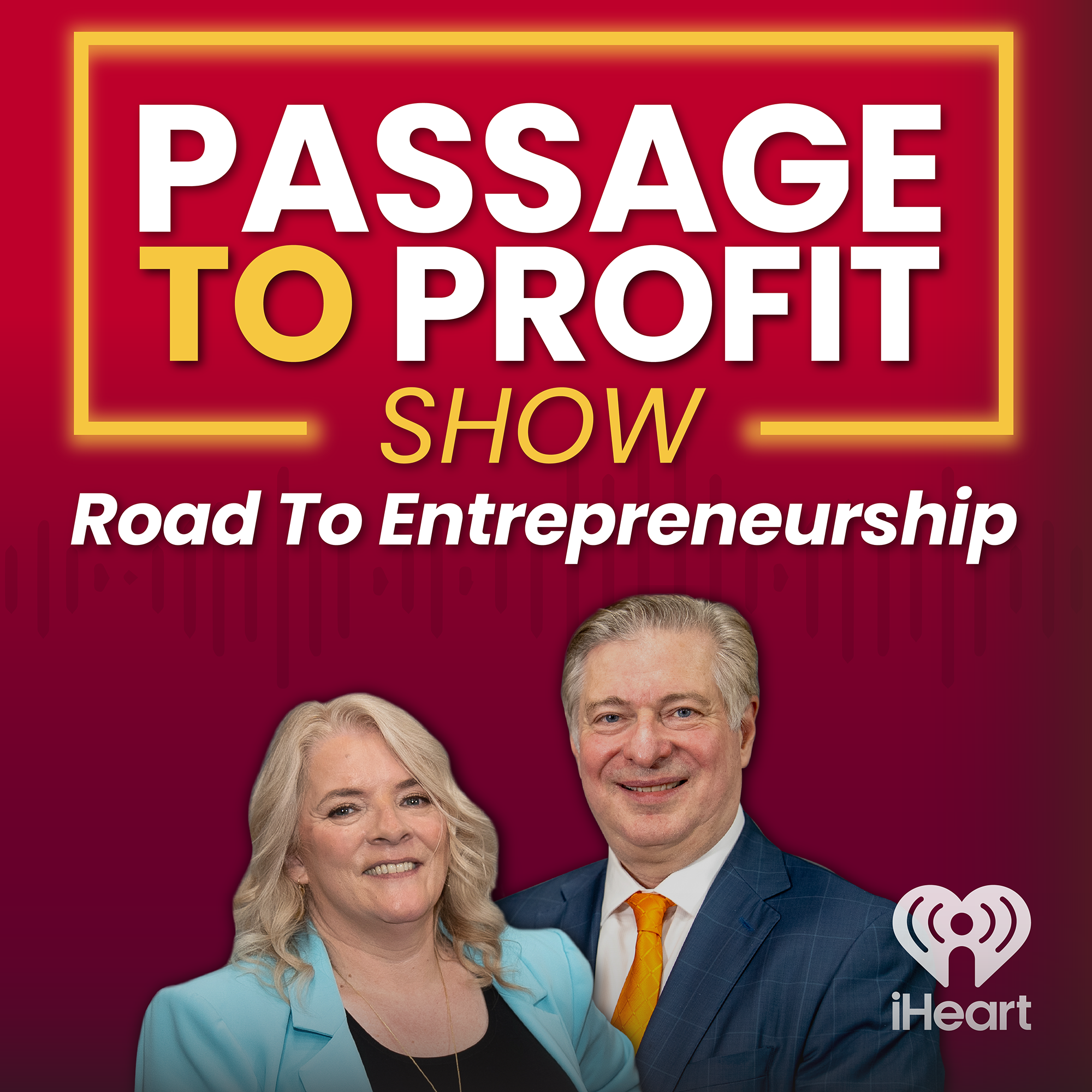
[00:00:19] Speaker B: It's Passage to Profit with Richard and Elizabeth Gearhart.
[00:00:24] Speaker A: I'm Richard Gerhardt.
[00:00:25] Speaker C: Hi, I'm Elizabeth Gearhart and we're your hosts.
[00:00:28] Speaker A: Welcome to the Passage to Profit show, the Road to Entrepreneurship podcast. Today we're celebrating our 300th episode, and boy, are we excited. We have all sorts of festivities around the studio. If you're looking at us on YouTube, you can see we have the studio totally decked out for a party. And we're going to have some surprises later in the show, but let's talk a little bit about our journey on Passage to Profit. Elizabeth, do you have any fond memories of your experience here?
[00:00:59] Speaker C: Probably one of the fondest is meeting Noah Fleishman, our producer. He's like, oh, you folks, it'll be great. I've known married couples that have been doing this for 50 years.
[00:01:10] Speaker A: And I guess this is one reason we stayed married, right?
[00:01:16] Speaker C: He was so supportive in the beginning. Cause we were terrified. We were like little church mice.
[00:01:21] Speaker A: We were like, ah, yeah, we were amateurs. I had done a little bit of radio when I was in college. College. But I never really considered myself any kind of polished radio person. And so starting out, I was terrified.
And I was never a great public speaker, so I was always very self conscious about speaking in public. Over the years, and especially with Noah's editing skills, I became less concerned about it. And so it's been a personal growth journey for me on many, many levels.
[00:01:51] Speaker C: We did get kind of wowed a couple times. So we had one guy come in, came with his wife. He had built this pillow for Edema.
[00:01:59] Speaker A: This was like in the old studio.
[00:02:01] Speaker C: This was one of the early ones. It was April 2019. So fairly shortly after we started, we thought he was going to talk about this Edema pillow. So he gets in front of the mic and he says, yeah, I actually died.
And what was weird was he's African American. His eyes were brown. When he came back to life, his eyes were blue.
I know.
[00:02:21] Speaker D: So we.
[00:02:22] Speaker A: And he did experience an afterlife, by the way.
[00:02:24] Speaker C: Yeah, he did. He said he was floating through clouds or something so that we had to like really think on our feet.
[00:02:32] Speaker E: I thought this was a bad show.
[00:02:33] Speaker A: I was like looking at the show copy. Where is this in the script? I don't know. What do I do now?
But Elizabeth, guests love you, you're such a great interviewer. Thank you. And it's always a pleasure to do the show with you. You ask those penetrating questions and you always make our guests feel comfortable.
[00:02:52] Speaker C: Oh, thank you. Well, they like you, too. They think you're the smart one.
[00:02:57] Speaker A: Boy, they get that one right.
But we've had so many great guests on the program, too. I feel like I've learned so much. And, you know, passes to profit is sort of tip of the spot beer type of content, Right. I mean, we get some of the most cutting edge business people and.
And we really started learning about artificial intelligence through the program.
[00:03:23] Speaker C: Well, our son first, but not that much, but yeah, we had some futurists come on here early on that were the super early adopters talking about it, right?
[00:03:34] Speaker F: Yeah.
[00:03:35] Speaker A: Kevin Serrace, I remember he came on during the pandemic, and this was when. Before AI was as evolved as it was now. And I asked him the question, well, can AI actually tell a joke? And he kind of tripped over himself. But now you go into ChatGPT and it does tell jokes. Not good ones necessarily, but they're there. So things have changed a lot.
[00:04:00] Speaker C: And then we had another episode where we had a presenter and he didn't really have a lot to present, and the guest was like, why are you here, man?
[00:04:15] Speaker A: He had like a hat and a logo,
[00:04:19] Speaker C: like, oh, my God, we have to trash that one. That's never going to fly. And I was like, no, no, I can fix it. And he did, and it came out okay. But yeah, that was like.
[00:04:29] Speaker A: I mean, in the early days, it wasn't always easy getting guests.
[00:04:33] Speaker C: You know, it's much easier
[00:04:36] Speaker A: now. It's easier because we're established. But we used to do these calls, like, we would go to these co working spaces and we would advertise ahead of time and we would ask people, they wanted to be on the radio, talk about their business. And it's like three people would show up, right? And I was like, free radio time, free airtime. You know, why wouldn't you take that? But I guess it just wasn't.
[00:04:57] Speaker C: It was terrifying for people. Now we've been doing it over eight years. We're in our ninth year, and publicists are sending us most of our people now, Right.
[00:05:06] Speaker A: So we just kind of kick back and hit the yes or no key.
[00:05:09] Speaker C: And, you know, well, we have Alicia do that. So we hired Alicia Morrissey. We started out with Noah, and then we hired Alicia Morrissey as our program manager. I was doing it all before Alicia and with help. But trying to get guests and schedule everything and send out emails and everything. And then we hired her and she just took over and has been managing this. She's amazing.
[00:05:27] Speaker A: She is super organized.
Everybody needs a person like Alicia in their lives because we couldn't do this without her.
[00:05:34] Speaker C: No, Alicia, what was that password again?
[00:05:40] Speaker A: And then Carolina, she does just the most amazing things on our social media. Now.
[00:05:45] Speaker C: We brought her in to work with our videos a couple years ago. No, a year. A little over a year ago. And yeah, the social media she does and the work she does with the videos is great.
[00:05:54] Speaker A: And of course, Noah, our producer, who is honoring us with a few minutes of his time to appear on the show today. So make sure you stay tuned for that.
[00:06:03] Speaker C: And now we also have Jodi Weinig who gives our guests the tour when they come into the iHeart studios. So she's very helpful.
[00:06:11] Speaker A: Absolutely. And the whole iHeart team, they've really just been fantastic over the years. They've supported us during some pretty challenging times.
So we're awfully glad to be here. Thank you, iheart. And also joining us today is Sonia Satra. She's a television actress and founder and CEO of Moticize. She's a mindset and fitness expert, not to mention speaker, advisor and former soap star of A Guiding Light and One Life to Live.
[00:06:39] Speaker C: And then after that, it is our immense pleasure to have a segment with Noah where he's going to talk about radio and his adventures and we'll reminisce with him some, but I think it'll be interesting because he's got a different perspective than most people. And then we have Lisa and Lauren Lane with an incredible product. I don't know how many of these I'm going to buy. I know it's at least one.
[00:07:01] Speaker A: It's called we have a lot of faucets in our house.
[00:07:04] Speaker C: No, I want it for it's called Rinsaroo and we'll get into the details of it, but I want it for traveling. I know my son's going to want it to wash his dogs, et cetera.
[00:07:14] Speaker A: And on top of all of that, we'll explore what our 300th episode has in common with Apple, Fox 5 wireless patents and a multi million dollar jury verdict. But first, it's time for your new business journey and we'd like to ask our panel this penetrating question. When you look back, what was the one decision or moment that most changed the trajectory of your business? And what did it cost you to make that decision?
Welcome to the show, Sonia. What Was the one decision that you made that changed the trajectory?
[00:07:50] Speaker E: Yeah, Gosh, I feel like.
Can I only say one?
Because I feel like there were two really. I feel like the first was just the decision to go to Hollywood because that changed the trajectory of my entire life, which really created the platform, I think, from which everything has evolved. And that was a big decision. Cause my family was very much the education. They've all got a million degrees, they have regular jobs. And I was like, hey, I'm gonna go to Hollyw.
So that was a. That was a big one. But I learned a lot because really, I think as an actress, you are an entrepreneur. And so you really. And you learn a lot about dealing with rejection and whatnot. So that probably was the single biggest decision that I made. And the cost? Oh, gosh, I don't know.
I got both. You know, you win some, you lose some with every decision you make.
[00:08:51] Speaker A: I guess you just decided to go to Hollywood. You didn't, like, have something lined up. You were gonna go to Hollywood with the purpose of being a star.
[00:09:01] Speaker E: So I had started in New York a little by mistake. Originally I had done a modeling thing. And while I was at college working in the dining hall for cash, I was just like, gee, I wonder if I could get some more modeling. Cause that's more fun than being in a dining hall.
So I looked in the New York Times.
Not a good place to look for modeling jobs, because it's every scam that you could imagine. And I ended up going to one of those scams and it was like, hey, give us $10,000, we'll make you a star. And thankfully I didn't have that, so that didn't happen. But through that, I ended up through a friend of a friend of a friend at an agency and I started doing commercials. And then I had summer and my sister was an engineer in la and so I decided to go out there for summer break and I auditioned for commercials out there. And that was really where I thought, if this is what I want, this is where I need to be.
So, yeah, I made the big call to my mom, like, hey, what do you think? And went back, packed up my very beat up Honda Accord and I had about $500 to my name. And my brother in law offered to drive across country with me because I wasn't sure my car would make it. And there I was in Hollywood. And so, yeah, it was definitely a rude awakening when I got there because I'd gotten a little lucky with some of the commercials I booked in New York. And then I realized it's not so easy after all.
[00:10:32] Speaker A: But you did do it. So you have that.
[00:10:34] Speaker C: I did it.
[00:10:35] Speaker A: That.
[00:10:36] Speaker E: I think it's that decision. There's one decision that everybody makes, and. And it's that one to be like, let's do it. Let's go.
[00:10:44] Speaker G: Wow.
[00:10:44] Speaker E: Yeah.
[00:10:45] Speaker A: I mean, every entrepreneur, I think, faces that moment.
[00:10:48] Speaker E: Yeah, you do.
[00:10:49] Speaker A: Absolutely.
[00:10:50] Speaker E: That decision of, do I go the safe route, or do I take a chance and live my dream?
[00:10:55] Speaker A: Lisa?
[00:10:56] Speaker G: Yes.
[00:10:57] Speaker A: What was the one decision that you made that changed the trajectory of your business?
[00:11:02] Speaker G: Well, gosh, there are a lot of them. I think we have more than two. But the one that really stands out to me, which was really tough, was jumping ship from our original manufacturer.
And as you know, you know, you guys being an ip, how important it is to have a great manufacturer. Well, our first manufacturer we kind of stumbled upon.
I had no background in manufacturing. We took whoever was available.
They were okay. But our first order of 5000 Rinse a roos arrived, and they were not what we thought they were going to be. So it was not good.
We did work with them for a bit. We worked through some issues, but they weren't great. And the thing is, we had invested in molds with them, Right. As, you know, $20,000 worth of molds. And when you're starting out, like, you're like, oh, well, if we jump from there, we have to go and pay again.
So turned out we found another manufacturer, also in China. They were willing, because they wanted our business, to drive to the other manufacturer, pick up our molds, and take them across the country or a couple hours away.
And, yeah, we did that, and it was the best decision we ever made. The new manufacturer is fabulous. They work with us. They're helping us scale.
We meet with them weekly. They communicate, and it was the best decision ever. So that was it. Jumping from manufacturer. Don't be afraid to leave if it's not good.
Sometimes there's something better on the other side.
[00:12:33] Speaker A: Well, you know, that's such a great story because it has so many lessons in it. And one of the lessons that I connected with was picking crummy vendors from the start because you don't know any better. And a lot of new businesses do that.
They're desperate or they don't have the credibility to engage and interest other, better partners. Right. And so you end up with somebody that is a big disappointment.
[00:12:58] Speaker G: Yeah. Yeah.
[00:12:59] Speaker A: And then you have to make the very difficult decision, am I gonna switch, or am I going to stick with this person?
And, you know, there's consequences to both. Right. They had your molds.
[00:13:09] Speaker G: Yeah. And then we're like, well, if we switch to this other one, how do we know they're gonna really be better?
[00:13:13] Speaker H: Right.
[00:13:14] Speaker G: Oh, it was another risk, you know,
[00:13:16] Speaker A: but, yeah, great story. Thank you for sharing that with our audience.
[00:13:20] Speaker C: Elizabeth, I've been thinking about this a lot, and I think that was the end of last year.
Well, the very first person we had on talking about AI was Kevin Serrace, like we said. And that was maybe. Maybe the middle of last year, towards the end of last year. And then towards the end of last year, everybody that was coming on the program seemed to want to talk about AI. So I said to Richard, I have a segment on how I'm doing with the studio. I want to give up that segment and make it into an AI segment.
And he said, okay.
And then he said, after a few of these, like, this is really good. We should make it its own podcast. And I said, yes, let's make it a podcast. And so I've been throwing myself in it whole hog, but I think it's getting a lot of attention, and it's really important. It was a good decision to go the AI route. I mean, there's a lot of people that are against AI. There's a lot of weird stuff going on with AI right now. But for me personally, using it and helping other people use it is important, and I think it's a really good decision. And it's a lot of work to do a whole nother podcast, because we do. We take segments from here, but we also do standalone segments for it, and there's a whole bunch of stuff that goes along with it, but I love it. So, yeah, it cost me more time, and maybe I'll have some people that are like, oh, you know, you shouldn't be advocating for AI, but I think I should.
[00:14:40] Speaker A: Now, you're the AI lady, right?
[00:14:42] Speaker C: Yeah, that's what they called me at podfest.
[00:14:44] Speaker A: Yeah.
Well, for myself, I guess, I guess starting Passage to Profit, I mean, with Elizabeth, was a big turning point for me personally. I mentioned earlier how I had to overcome my fear of public speaking, and so that was a step forward for me, and it's exposed me to a lot of really interesting people. I feel like I'm the tip of the spear when it comes to new business ideas, and I love that part of it, and I look forward to the program every week and sharing all of our guest knowledge with our audience.
Hopefully, they're finding value in the things that we have to present.
And I just think that, you know, having a voice and being a participant in the discussion is a real honor. So I feel very grateful for the opportunity that we.
Well, what if the biggest thing holding you back isn't your talent or your circumstances, but your own brain? Today's guest is a friend of the show and a returning guest, Sonia Satra, the founder of Emoticize, a keynote speaker and an actress. So welcome back, Sonia. Thank you. Always so nice to see you. For sure. For sure. We want to talk a little bit about your book, what if it were easy book, right?
[00:16:03] Speaker C: Yes.
[00:16:04] Speaker A: And we've talked about it before. We also want to talk a little bit about the entrepreneurial angle, the value to an entrepreneur of publishing a book. How did it help you in your career and how did it happen?
[00:16:18] Speaker E: I think there's a great value for writing a book. I think one, it solidifies your expertise. You have it in paper, you have. Here you go. You can hand it out.
Someone once said it's like an expensive business card and not totally wrong about
[00:16:32] Speaker A: that, but
[00:16:35] Speaker E: it's a great product to have and it definitely gives you lots and lots of material to work from. It helps a lot with speaking, which is something that I do. A good bit is to get out and speak. And people always are ready to hire you if you have a book from a credibility, from an expertise and from a speaking opportunity. It's a game changer for someone who's
[00:16:57] Speaker A: never written a book but thinks they might be interested in writing one. What was the process like and how did you pull it all together?
[00:17:07] Speaker E: You know, I actually wrote three different versions of this book completely three drafts of it. I think it was trying to figure out what was the way, the best way to present it. Moticize has seven steps, but I also. It includes movement. So how was I going to integrate movement? It's really hard to read about fitness. So I ended up having QR codes where people could go straight to videos and actually do the mindset with the movement so they could experience it. Because that was one of the things that was difficult speaking about something that's so experiential. So it was finding a way to incorporate that into the book so they could not only read about the mindset piece and the science and all the things that were backing it up, but then they could actually do it and feel it for themselves.
[00:17:51] Speaker C: So a lot of people that write books go on a media tour. What did the media tour do for your book? Did it really help that much?
[00:18:01] Speaker E: The truth exposed So I think, look, one client and all the referrals makes a huge difference. So, yes, it definitely does have that. Do you sell a lot of books on a media tour? I think podcasts are actually one of the best things to be on in order to sell books more than it was some of the mainstream media.
[00:18:25] Speaker C: Did you go on like abca?
[00:18:27] Speaker E: Yes. So I did a lot of morning shows and toured around, and that was super fun. It was just fun to be back in a studio on TV and talking to people. And it also generates really great social media, so you're out there. It's also something you can use to send to speaker bureaus or whatnot to show that you can speak and people care.
And so it helps from, again, sort of solidifying yourself as an expert. And it definitely made a lot of great contacts that I definitely still keep in touch with today. And I value including you. I wouldn't be here if it weren't for that. An interesting thing with Moticize, because I originally came out of the gate thinking it was more of a fitness program with this mindset component that could really change how you feel and the ideas you come up with. But what I learned was that fitness people don't necessarily want to do the mindset, but mindset people or entrepreneur people will do the movement if it will make a difference. And so I definitely, I moved away from making it really so fitness oriented. And I really focused on the fact that it was. It's a mindset program, but the moving just accelerates it and opens up your brain and it. And it really, it makes you so much more creative and focused and motivated. And there's tons of science behind that. And as a result, you'll also get the exercise.
[00:19:49] Speaker C: So I do want to say that when I met Sonja, I was putting the studio together, Gear Media Studios, and Sonya said, I see you out there giving presentations.
[00:20:01] Speaker E: I was like, day one, I said that.
[00:20:03] Speaker I: You did.
[00:20:04] Speaker E: I was like, oh, no.
[00:20:06] Speaker C: Oh, no, Sonia. I have to say, in the last year, not even a year, I have given presentations at three national events. Yes. And that's like, it's not just somebody's school classroom. These were big deals and I do enjoy it. It's a little frightening, but. But I have a good coach and she looks at all my slides and, you know, we go over everything together and it does feel like a good fit once I get over the whole stress piece of it, which I'm working on. But I do feel like our Friday sessions where I. We walk and we talk right It's a great coaching technique.
[00:20:44] Speaker E: It really is. Because I think often, and I say this to all entrepreneurs, a lot of times you're sitting at your desk and you're trying to come up with an idea and you're trying to think, and then you can't and you're stuck. And you get up and you go get some water, you go, you know, walk somewhere, and all of a sudden you're like, ah, I got it right. And that's not a mistake. And so that movement actually generates a change in your brain, and it opens up the channels to creative thoughts. And there's something about the movement, too. You move your body, you move your mind, you move through the emotional things that can sometimes hold you back. And so it really does help you break through some of the blocks just naturally.
And then you come up with other ideas.
[00:21:28] Speaker A: That's great. One of the things that you talk about is limiting beliefs that we have, limiting beliefs that limit our ability to be successful in business. Talk a little bit about that.
[00:21:40] Speaker E: Where do you want me to start?
I think we all could probably say, yes, they exist, right? There's always that little voice in your head saying, no, you can't do that. You're not good enough, everybody. It's amazing. The most successful people say, still do. I'm always surprised, like, really? They think that too.
And sometimes the most successful people have it even more. So it's really.
It is that old saying, you know, feel the fear and do it anyway. You really have to choose, be at that precipice, right, of are you going to take the safe route or are you going to take the risk? And as we know, we just heard, even the decisions that you make can hugely transform your life and your business.
[00:22:24] Speaker A: So you're a believer of putting yourself out there and taking a risk. So how do you coach people who are less willing to do that?
[00:22:33] Speaker E: I found that there's two kinds of people. There's the people who need the really small, tiny steps. And that is a very effective way because it gives you evidence. Every time you take a step, you have evidence you can do it. And so you build on that so it makes sense. It's a very logical way to go. And you're like, well, you can do it because you just did that. So take another small step and another one and another one until you finally get to that precipice.
And then I think there are some other people and a lot of entrepreneurs, I do find this inherently have that. Of the small steps, they. They don't they're just like, it's just too many details. It's just like, come on, give me a big, juicy, like, big goal. And sometimes they need the big goal or the big step. And then they'll bypass all of the fear of the little steps and they'll just go for the big one. So it depends a little on that personality.
[00:23:22] Speaker C: When Richard started Law firm and I helped him, we had money saved. So it wasn't like we had to be profitable on day one when I started the studio. And I'm doing this AI consulting business now and speaking I'm still working for Gearhart Law. I still have my day job, which takes a lot of time actually. But I don't have to make money day one because I have money coming in. What about people that don't have money coming in that decide to take a leap? How do they fund it? Like, what do they do?
[00:23:50] Speaker E: Well, I think you do still have to fund life somehow, right? So whether you have some other job that funds it while you're figuring it out, or you take a loan. I know my husband was a. He's a producer or television producer, and we, you know, highs and lows, but at one point he took the leap and we took a second mortgage on our place because we were like, okay, let's give it a shot. I believe in you. Let's go for it and see what happens. And if it doesn't work, we'll figure it out. Now, I wouldn't advise that for people who really can't handle that risk taking choice, then I'd say hold on to your day job while you figure it out. It takes a little longer. It's a little harder that way, I think, because of the time factor. But there is something, you know, people used to say that to me about acting all the time, you know, like, but don't you have a backup plan? And I used to hate that because I was just like, a backup plan assumes or presumes that I'm not going to make it.
And I'm like, you know, sometimes you just have to just burn the ship and just go and, you know, you'll figure it out. If you have to go back or swim back to shore, you will swim back to shore. But you have to go with that vision and the persistence and the 300 or 3000 episodes until you get there.
And so I guess I just say sometimes you just have to take a leap of faith. But you have to pay your bills, so, you know, you do need to eat. So somehow you have to Figure out how to do that.
[00:25:23] Speaker A: Well, we're having a fascinating discussion with Sonia Sartra who is a television actress, speaker, author. She does it all. We have to take a commercial break, but we'll be back with more passage to Prophet right after this.
[00:25:37] Speaker H: Do you hear that? That's the sound of uncertainty lurking under your hood. You know the feeling. I know I do. That sudden sinking sensation when you see a check engine light or your car unexpectedly breaks down and you're faced with sky high repair bills. It's time to shield against unexpected repairs with Car Shield. Car Shield is America's most trusted auto protection company and has an A rating with the Better Business Bureau. Don't let the fear of a breakdown keep you up at night. Trust the Shield Car Shield. And say goodbye to terrifying repair bills and hello to peace of mind. Your plan also comes with 24. 7 roadside assistance, courtesy towing, rental car options and so much more. Don't wait till it's too late. Call Carshield now before a breakdown. Protect your wallet. Protect your car with Carshield. Get our best protection ever. Call now. You'll thank me later. 8002-6121-7680-0261-2176. That's 800-261-2176.
[00:26:36] Speaker B: Have you outgrown your health insurance plan or just not happy with what you're paying for? The number one reason we only all change our health insurance is price. Are you paying too much for your health insurance? Would you like to have better coverage at a better rate or at little or no cost to you? Your life needs are always changing, but have you done anything to improve your health insurance for you and your family? Health insurance laws and coverage are always changing and getting better. It's impossible to do all the research yourself, but now it's all done for you for free. So regardless of your age or medical condition, take a few minutes right now and find out if you can save money or even qualify for zero cost health insurance in your state. Call now.
[00:27:23] Speaker H: Paid for by cheaper health insurance. 8006-5214-7080-0652-1470.
800-652-1470. That's 800-65247.
[00:27:37] Speaker B: Now back to passage to profit once
[00:27:39] Speaker A: again, Richard and Elizabeth Gearhart and our
[00:27:42] Speaker C: special guest today, Sonia Satra. Sonia is a return guest and she's written a book. We've talked about that. But one thing we really wanted to explore with her, she's a very spiritual person and she travels a lot and she does different experiences related to spirituality, I guess. And I don't know exactly what you would call it, but she wanted to talk a little bit about how the spiritual part of a person needs to be expressed, especially when they're an entrepreneur. And that gets neglected. Right.
[00:28:09] Speaker E: I think what I have found over 20 years of coaching is that we know mindset is critical. That's a huge part of your belief system and your ability to keep on going and persisting. The body was also. The body keeps score. Right. We know how that. And we have. And I always believe that the answers are locked within you like it's in your. And you can access it via the body.
But I think the other piece that I have noticed time and time again is this X factor, and I call it the soul, the spirit, energy, universal, whatever you want to call it. But it's this other thing that when you can, you know, often people will refer it. Refer to it in manifestation. It's this energetic that gets created that's connected to something larger than yourself. And when you can align the three of those things, it is just incredible how quickly things can really take off. And so I feel like it's really the trilogy that works. So much so. And so I think that's a piece that I'm talking about a little bit more I'm exploring how do we actually bring that into business coaching? Because it's. It's often you don't talk about it. Right. Like, oh, we don't talk about that in business. Right. But it's more and more. I feel like it's that thing that also helps you tap into your intuition, and it helps to keep you grounded and aligned with your truth and your highest frequency of energy. That is what goes out into the universe, which comes back to you.
There's a really cool experiment around energy. There's these five goblets. They have five different emotions in them, a frequency. It's obviously in a lab. You wouldn't be able to replicate this at home. And then you have a tuning fork, and it's tuned to one of them. So say you have anger, sadness, happy, shame, I don't know, choose whatever, jealousy. And then you have the tuning fork to happy, the same exact frequency as the happiness one. When you spin the. When you do the tuning fork, the frequency of that sound goes and it matches the happiness frequency in the goblet. And it. It makes that so big and so it expands it so much that that goblet will explode. The other ones, absolutely nothing happens to. Yeah.
[00:30:35] Speaker H: Wow.
[00:30:36] Speaker A: This is a Real thing.
[00:30:37] Speaker E: This is a real thing. This is the power of our energy, our frequency. So. And I feel like it is this. That's why I say it's this X factor. It's something else. And modus eyes often will generate it, because I think movement will help you unblock it. But I also think the more clear you are with tuning into it doesn't have to be religious. It can be, if it is, or it could be spiritual, or it could be. It's. It's this frequency, this energetic, because that is what's going back out, and that is what people instantaneously feel. And that's the kind of energy that you get back to you. And that, I think, is what makes what elevates people and their ability to tap into success even more effectively.
[00:31:26] Speaker A: So I'm trying to find calm, more calm in my life.
But this sounds. When you. When we talk about energy, it sounds like almost the opposite of calm. But then there's another part of me that says, well, maybe that's the same thing, because by being calm, you're letting yourself get in touch with this extra energy.
[00:31:48] Speaker E: So I know we want calm, right? Because most of us are going around anxious, and there might be just a couple things happening in the world to make us that way.
So there's nothing wrong with being calm. We want to be grounded in our. Grounded. I think I like grounded more than. Let me be calm, especially because I did your Sphinx code. I do the Sphinx code thing, right.
And I know that calm isn't actually
[00:32:12] Speaker C: necessarily
[00:32:16] Speaker A: three towers or something.
[00:32:17] Speaker E: You have three towers, you go to force. You are actually like the Jedi, right? So for you, movement's actually really powerful and really being in tune to what is it that you want. You, like, have a very big energy. So trying to. I'm going to repress that and be calm. Well, yeah, it's probably not going to work, right.
It's not your specific highest frequency of energy. So while we don't want to be off the rails, we're not trying to get into anxiety or anger or any of those things that can derail us completely. We want to try to get into that place. For you, it would be this combo of this mind, body type thing. So when you work out or when you're doing something that you feel great, think about something that you did that you feel so proud of.
[00:33:06] Speaker A: Yeah, sure.
[00:33:06] Speaker E: See, look, your energy is just like, phew. In that one second, it changed. You could see it. Like, you lit up, your energy changed. Your eyes lit up. There was a spark so when you think of something that you did that you feel really proud of or something that makes you feel strong, then you just suddenly, it's almost like you expand, and that is your most powerful energy going out. And that is, I think, the place that we want to try to tap
[00:33:32] Speaker A: into that is I'm definitely a doer, and I get my satisfaction out of life a lot from, you know, accomplishments.
[00:33:42] Speaker C: And speaking of which, the one he was thinking of. I know Richard did an Olympic level triathlon last weekend.
[00:33:52] Speaker E: That is amazing.
[00:33:54] Speaker C: That is so hard.
[00:33:56] Speaker A: I was grateful that I didn't have a heart attack.
[00:33:58] Speaker C: That's the only one I know I've ever known who's done that. I mean, that is awesome.
[00:34:03] Speaker E: Talk about the fact that you did that, right? Like, and that feeling, that is like your vibrant energy. That is who you truly are.
[00:34:13] Speaker A: It was a five year goal. I mean, it took me five years to, you know, to get to the point where I could survive.
And so, yeah, I feel great about it.
And it's for me personally, when I need energy, I'll go back to events in my life where they were powerful for whatever reason. Maybe it was a business success or a personal success, success. And I'll draw on that. And that gets me back into that mode where I just feel like moving
[00:34:44] Speaker E: forward again sometimes, just taking a moment, being calm. You know, there is a place where you could just settle and then just refocus. Okay, let me think about this. What was it that made that happen? Why did that whatever it was that you achieve happen, and then you go back and that's who you really are. That's what you have.
One of my questions in my book, what do you have? Right? And it will also just organically start to regenerate that natural feeling, that natural energy. And even just an exercise with grounding, you could imagine that you have like a swirl of energy kind of coming from above and from like, deepest, deepest into earth and coming in and sort of swirling. And if you need to reel in your center so that you've got like, you're grounded from above, grounded from below, but you can also imagine your roots coming out of your feet and going down to the center of Earth. That's a really great thing to do before you speak, actually, because at that point, you're freaking out and you're just like, I don't feel grounded at all.
[00:35:52] Speaker A: I feel ungrounded. I feel elevated.
[00:35:55] Speaker E: You feel like I fly off the stage into the back of the room.
[00:36:00] Speaker C: So can you say, stay in a state like that if you're doing things that don't feel aligned with yourself, it's a lot harder.
[00:36:08] Speaker E: It is a lot harder. Which is why you can tell when people are out of alignment. Because you can see there's just their energy is a little bit fuzzy. They're not really present.
They're not as grounded.
It's almost like it's their heart space, their heart energy isn't coming out.
There's a sort of their eyes usually don't have the spark. Like as soon as I mentioned, you know, think of something that you did, you're just like, you know, so. Yes, I think a lot. And that's one of the reasons why I think it's so important to notice that and to really tune in. And what is it that you feel guided to do? What is it that you feel you're really here to do? How can you serve some greater purpose? Because that will also help you really get deeply aligned.
[00:37:01] Speaker A: I just love listening to you, Sonia. You have like, such amazing insights. We're with Sonia Satra, author of the book what if It Were Easy? And you can get a lot of your wisdom in the book, right? Yes. And where can people find you if they want to reach out to you to talk about spirituality or motorcycles?
[00:37:20] Speaker E: Sonyasatra.com My name S O N I A S A T R A dot com and I'm on all of the social media things as well.
[00:37:28] Speaker A: Great. Well, thanks so much.
[00:37:30] Speaker E: Thank you.
[00:37:30] Speaker C: Okay, well, that was awesome. Now it is time for real AI Use cases Business Owners Roundtable. So, Sonia, I'm going to start with you. What's one way you're using AI on a regular basis?
[00:37:43] Speaker E: I use it just for brainstorming, creation of ideas, editing videos. I actually just got this really cool AI clip where I was able to take a picture of me and make it move as if it's walking down a hallway. Almost like I was walking down. It was. It's actually really cool.
[00:38:01] Speaker C: So, okay, so I'm going to go to Lauren Lane next and then to her mom, Lisa. So, Lauren, what's one way you're using it?
[00:38:08] Speaker F: Awesome. So I actually joined the business this year and using AI has been the number one way for me to get up to speed. Speed and learn.
All of the major platforms that we sell our product on have AI incorporated there for sellers to really be successful. So it's been a tutor for me
[00:38:27] Speaker G: as a brand owner. It's always challenging because we're constantly having to make content.
[00:38:32] Speaker E: Right.
[00:38:34] Speaker G: So believe it or not, I could go onto TikTok now, instead of making my own video, I can ask TikTok like, hey, here's an image. Turn this into a video.
Boom. My video is now. Or my image is now a video on TikTok. So it's a time saver and it helps generate sales. And TikTok does it. Amazon's doing it. It's getting better every day. And what was a decent video is becoming a really good video with time. So that's one way. Yeah.
[00:39:01] Speaker C: Wow. Richard Gearhart.
[00:39:03] Speaker A: So one of the things, one of the projects that we have is that Gearhart Law wants to have sort of a bigger voice in what's going on in the intellectual property community.
And there are a lot of rules that are proposed by the Patent Office.
There's some major legislation right now that's pending in Congress called para, which is the Patent Eligibility Restoration Act. But we're using AI now to sort of scan the regulatory landscape and use artificial intelligence to notify us about different activities at the Patent Office and in the legislative branch. That'll give us the opportunity to give an opinion about whether a particular rule relating to intellectual property is something that supports entrepreneurism or doesn't. And so it would be virtually impossible to track all of that stuff without a staff of people with AI. We are just setting up the algorithms and it'll sort through it and give us notifications of content that we think would be appropriate for us to comment on.
[00:40:14] Speaker C: When I gave this last presentation on AI and marketing, I asked everybody in the audience, like, how many of you does it send down the rabbit hole?
Everybody raised their hand, but. So I did kind of go down a rabbit hole of perplexity. But it was a rabbit hole. I was happy I went down. We were talking about the Gearhart Law website and it could only find the most recent blogs that our marketing agency did that had optimized their blogs for answer engine discoverability. Right. So the ones our previous marketing agency did were not in the right format to be discoverable by ChatGPT, Gemini, etc. Which Gearhart law now does get quite a few leads and clients from the large language models. And it said, well, you're not doing a lot with your passage to profit show content. How about if I pull blogs out of that for the. Especially the IP and the news section and just write blogs for you?
And I was like, let's try one. And it did, and it quoted Richard and it was a really good blog post, but we can't really use it for that because our marketing agency is doing our Blogs and that it's just be too much. But I do want to start doing that for Passage to Profit because we haven't. We have a website for Passage to Profit a lot of social media, but we don't actually have any blog posts. And the answer engines love blog posts. They love the structured content.
But it was funny because I was just in the perplexity LLM. I was not trying to use it as an AI agent and it was almost acting like an agent.
So for those of you who haven't heard of agents before they do a series of steps for you, I am going to try to really experiment with that and use it more.
[00:41:48] Speaker A: Maybe you want to tell the audience a little bit about what you presented on in Indianapolis because it is AI related.
[00:41:55] Speaker C: Okay, yeah, sure. So I was talking to a CPA group. So CPAs have a national organization and they have state chapters. So these were the marketing people for the state chapter. So I was talking on AI and marketing. So I went through the usual stuff which to me and probably to you guys too, seems really old hat by now. Yes, you can do newsletters, yes, you can do emails. Yes, you can do communications. But make sure you check it all. Make sure you do it in your own voice.
And watch out if you don't pay for an LLM, if you don't have an enterprise version, don't share anything you don't want out in public because it's like you're running down the street naked.
[00:42:33] Speaker E: That's a good analogy.
[00:42:35] Speaker A: Gee, I never thought of it that way.
[00:42:39] Speaker E: We'll never get that image out of our lives.
[00:42:43] Speaker A: And now I'm thinking about all these ChatGPT users I know and do I really want, want to see this? Yeah.
[00:42:50] Speaker C: Okay. Well, thank you, everybody. This has been real AI Use Cases, Business Owners Roundtable. It's been edited to fit the radio spot, but it's also its own separate podcast where you get to hear the whole thing. And we put that on YouTube and also anywhere you get your podcasts. Passage to Profit with Richard and Elizabeth Gearhart. We'll be right back.
[00:43:09] Speaker I: Here's a real life story that affects 50% of all of us out there. It's called Divorce. If you've gotten divorced and now you're struggling to pay your bills and your credit card debts are complete, completely out of control. You need to call this special debt relief hotline right now. We help people with all kinds of money problems caused by different life challenges. A divorce, a job loss, even heavy medical bills. All these life events can sometimes financially stress you out and cause you to get out of control. We help people get their lives back by showing them ways to consolidate and reduce their debt, in some cases for a fraction of what they owe. If your credit card balances are more than $10,000, call us and learn how to reduce your credit card bills and monthly payments. Now. Here's our number paid for by Debt.com.
[00:43:53] Speaker H: call now at 8008-1008-5780-0810-0857 800, 810, 0857. That's 800-810-0857.
[00:44:08] Speaker J: Learn how thousands of smart homeowners are investing about a dollar to avoid expensive home repair bills. John a former non customer said, my air conditioner broke and I had to spend $1,900 to fix it. Jeff, A customer wrote, my air conditioner broke and I got a new one at no out of pocket cost. Mary, a former non customer, wrote, my heating system stopped running. I had to spend $3,000 to get a new one. Lisa A customer wrote, my heater stopped working. I got it fixed at no out of pocket cost. For about $1 a day, you can have all the major appliances and systems in your home guaranteed fixed or replaced. Call now. If the lines are busy, please call back.
[00:44:50] Speaker H: Call the home Warranty Hotline now at 8002-5549-4080-0255-4940.
That's 800-255-4940.
[00:45:07] Speaker A: Passage to profit continues with Richard and Elizabeth Gearhart. Quick shout out to our friends at WRNR AM740 and FM 106.5 in Martinsburg, West Virginia. Thanks for listening. And if you're new here, Passage to Profit is a top ranked entrepreneurship podcast and radio show heard in 39 markets. It's a place where founders share what really works. And now it's time for Intellectual Property News. We're celebrating our 300th episode. So naturally I went looking for an intellectual property story involving the number 300. And I found one. A $300 million patent verdict involving Apple. The case involved Otis Wireless, a company that owns patents relating to lte.
That's the technology that allows smartphones and other devices to communicate over 4G cellular networks. Optus claimed that Apple's iPhone, iPads, and Apple watches use technology covered by the five of its patents. The dispute has been going on for years. In the first trial, a jury awarded Optus more than $506 million. That verdict was set aside and a second jury awarded Optus, you guessed it, 300 million. But Apple appealed again. The Federal Circuit threw out the $300 million verdict because the jury had been asked one combined question covering all five patents, instead of asking the jury for a decision on each of the five patents individually. In an IP case, there has to be an infringement finding for each piece of ip, so lumping it all together is not allowed. So the case got tossed out on appeal and went back for a third trial, and this time in February of 2026, the jury found that Apple did not infringe any of the five patents. That means a case that once carried a $300 million verdict ended, at least for now, with Apple owing nothing in the United States.
The moral of the story here is that litigation is inherently uncertain. In one trial, the verdict was $506 million against Apple, and after appeal, the verdict was $300 million against Apple. And in the third trial, the verdict was zero against Apple. Same facts, same patents, same technology, mostly the same lawyers, Wildly different outcomes. Cases like the one above involve super complicated technical issues, multiple claims of multiple patents, and it's very difficult for anyone to ingest it all, including a judge or jury. Clever counsel can confuse the issues or a judge or jury can have a bad day. The complexity of it all makes outcomes difficult to predict. When people want to go to court, I do my best to remind them that even if you have a good case, you can spend a lot of time, money and hassle trying to sue somebody and you may not even get the verdict that you want or think you deserve. It's usually best to try to resolve the matter without litigation. Of course, sometimes litigation is inevitable and often you're the one challenged and you have to defend your technology and your business. So on our 300th episode, the 300 million dollar lesson is simple in litigation. Hope for the best, but prepare for the worst. And if you have an idea or an invention you want to protect, the team at Gerhart Law helps entrepreneurs turn IDE into protected assets. You can visit learn more about patents.com or learnmoreaboutrademarks.com for a free consultation and practical guides to get you started. And later, secrets of the entrepreneurial what successful founders think that most people never see.
[00:49:02] Speaker C: I am delighted to introduce Noah Fleishman, producer of Passage to Profit. He is a radio professional who has been in the industry long time. We started with Noah as we said earlier and we were in good hands and we still are. So Noah, what do you think is important for producing a radio Show.
[00:49:22] Speaker D: Oh, my goodness. Elizabeth. First of all, I just want to congratulate the two of you on the 300th presentation of Passage to Profit. Fantastic.
[00:49:32] Speaker A: Yeah. You know, 300 is a perfect bowling score. It's also a great RBI average for a ballplayer.
[00:49:40] Speaker D: Absolutely, Richard. And if people only knew what went into the celebration here today. Oh, my goodness. The party hats, the streamers, all these things around us, I mean, they could make, you know something. This week I had the opportunity to take part in the guest coordinating process of Passage to Profit, what our friend Alicia Morrissey does, coordinating the guests and pre interviewing and all that sort of thing. I mean, here I am producing the show every week, and yet I wasn't even aware of the intensity that goes on in the preparation of the guests. I thought to myself, you know, with all this preparation going on, this is not your typical radio show. This is a documentary could be done on this. You know, we could get like.
[00:50:20] Speaker A: We're still waiting for A and E to come and zoom in here.
[00:50:24] Speaker D: We could get like in the old days, we could get like the Maisels brothers or DA Pennebaker to come in and do the black and white documentary on Passage to Prophet and how it's done.
But, Elizabeth, you asked me what is involved in producing great radio, shall we say, or the term great radio, which is such a buzz term or a buzz phrase that I've been hearing for so many years. What is great radio? Great radio, as I find it, is in the. You know how they say beauty is in the eye of the beholder? Well, great radio in many ways is in the ear of the listener. And it involves great conversation. It involves a certain fluidity to the. The talk and the conversation that goes on. Sort of the opposite of what's happening right now. But anyway, as I was saying. But no, to produce Passage to Profit, it's. It's quite a delicate process.
[00:51:16] Speaker A: You have that host egos to, you know. Yeah, egos are a big part of maneuver around, right?
[00:51:22] Speaker D: Actually, yes.
[00:51:23] Speaker A: Yes.
[00:51:23] Speaker D: But actually, Richard's joking. What happens is for something like Passage to Profit, we have guests from all walks of life, all walks of the world, all professions, and you never quite know what you're going to get when you open that box. That's the thing about Passage to Profit. It's not your typical, let's bring these news people in here, these newsmakers and these politicians, and we're just going to have a discussion. That's kind of what goes on everywhere. But Passage to Profit is a little bit different. We're going to talk to people from all different parts and all different. And, you know, Shark Tank, for example, which is the only thing I heard out of Richard and Elizabeth Gearhart when they first came here, oh, we want to do Shark Tank on radio. And I said, well, you know, maybe I think we're going to do something a little different. We got something a little better going on right here, actually. Something a little more introspective. Talking to folks about how they started, where it came from, where the idea happened. Those are the interesting parts of entrepreneurship. But in television, of course, it's very directional. They'll bring you into a room and they'll. They'll give you the talk. They'll work you over a little bit, and they'll say, okay, you're gonna say this, you're gonna say that. You're gonna do this, you're gonna do that. Bang. And, you know, we roll on passage to profit. It's a little bit different. We kind of let the action happen. And I'm kind of like the. The D.A. pennebaker. I'm kind of like the Albert Maisels. I'm the one capturing all the action. And then we bring this to the radio somehow. And it's. It's a fascinating process. It really is. I can't believe that we do this every week, let alone 300 of them.
[00:52:46] Speaker C: And how do you decide what goes on the cutting room floor, Noah? Because we tape for a long time, and you cut a lot of it out.
[00:52:53] Speaker D: If it sounds good, Elizabeth, it stays in. What does sound good mean? Sounds good means you can understand it. You can catch the action. You know, this is a radio show. I know we do. We're on video, we're on YouTube. We're a podcast. We're all these different things. But the fact of the matter is that it needs to be heard. Radio needs to be. There's an old quote from the late, great Alfred Hitchcock, and he pointed out in a quote that we used to hang on the walls in our radio station for years. The quote was, in radio, sound is a very important element. Now, this was Hitchcock, of course, and he was a little bit of a character. But what does that mean? It means that you have to be cognizant of being able to hear everything that's being said. You know, when you have these moments on these television or radio programs, Television also, tremendously. You've got people on a panel talking over one another, and they start laughing with each other, and they start going into all these collective chatter moments, and you can't put that on the radio necessarily because you can't hear what this person just said. If a joke happens and everyone's roaring with laughter and you didn't hear the joke, well, that can't happen. I can't leave that joke in because unfortunately no one heard it.
But it was a great joke, trust me.
[00:54:10] Speaker A: One of the things that really captured me about you is how much you love the medium, how much you love radio. Where does that come from? Where does that passion come from?
[00:54:22] Speaker D: I thought you were going to tell me, Richard. You know, you've got a little bit of that passion yourself actually.
[00:54:27] Speaker A: Oh, it's the old producer's truck turned it back on the host. I see.
[00:54:31] Speaker D: Well, no, actually the truth is it. It comes from exposure to the medium at a young age, I think. You know, I had this experience when I was about 11 years old when we.
It's a long story, but my family and I took a trip to Minnesota, of all places, and we stayed at a Holiday Inn. And in the basement of the Holiday Inn there was this radio station, a music station. I'll never forget it. It was KNXR radio. It was one of these classic beautiful music stations from the old beautiful music days. And they had their headquarters in the basement. And I found myself just fixated, just staying by the display window of the place, just looking at all the operations and what was going on. And the folks inside were very friendly. They invited me in, which I didn't believe, and they said, yeah, let me show you what goes on around here. And they were showing me the operation and it was fascinating. Now my fascination with radio went long before that. I was this insomniac child in my parents home, getting up at like 2 o' clock in the morning when the whole house was asleep.
And as I walked past the bedrooms there would be radios on at the bedside. Because my older folks, my elders, were folks that grew up in the great days of radio, going back to the war years and that sort of thing. And these were radio kids, they were raised on radio. So many years later I would be this insomniac child at two in the morning walking past the halls, hearing these discussions that were going on on Talk radio at 2 o' clock in the morning. And I'm saying to myself, this is an 8 year old child saying to himself, what could these people possibly be Talking about at 2:30 in the morning that's so interesting. And of course many years later, and it became sort of a life quest. I had to figure out what is so involved at 2:30 in the morning that it becomes radio at that hour. And many years later, I discovered it. Some of it's on right now.
[00:56:20] Speaker A: Yeah. I mean, radio has always been a part of my life, though. I mean, I can remember as a young kid, every morning listening to WGN in Chicago.
[00:56:29] Speaker D: There you go.
[00:56:30] Speaker A: And we were getting ready for. I was getting ready for school. My parents were getting ready for work. We always had the radio station on. And, you know, that was before we had the Internet and cell phones and all this other stuff.
[00:56:44] Speaker D: In other words, Richard, it was before we had all the distractions.
[00:56:48] Speaker A: Right.
[00:56:49] Speaker D: You see, that's something else about great radio, which is that there was just a little bit more concentration in the way people listened at that time. There's this big war on, this big struggle fighting for attention space. Elizabeth knows all about this because she talks about it practically every week on this show. The war for attention space.
[00:57:09] Speaker A: But, you know, back in those days, it didn't feel like a war, you know, and probably was, because there was advertising. I mean, radio was a business.
[00:57:17] Speaker D: It wasn't the war that it is.
[00:57:19] Speaker A: But now it's a crazy war.
And because everybody has access to the public airwaves in one shape or another, which is great. I think it's a great democratization.
[00:57:31] Speaker D: You're talking about democratization. But I will tell you that what's going on right now could be called attention anarchy in many ways.
[00:57:38] Speaker A: Yeah.
[00:57:39] Speaker D: And there's no getting around that. That's just the nature of what's been introduced into our culture. You know, that was one of those little things that not a lot of people thought about when they started inventing all these things.
[00:57:49] Speaker A: Yeah. I mean, it's so. It's so. It's. There's so much that it's nothing. Because there is so much.
[00:57:55] Speaker D: So much that it's nothing. Write that down. That's gonna be the subtitle of the show. So Much that it's Nothing.
[00:57:59] Speaker C: There is one place where radio wins, I think, over everything else.
If you're driving in your car and you maybe can't even put a podcast on because you're trying to pay attention to your driving instead of fumbling through podcast titles.
At least me, my personal experience, I'm listening to the radio and I can tune through different stations. I'm not. Even if Richard's in the car, we might be listening to a podcast. But those kind of take some concentration. Like, I want to just listen to the radio, and then when I'm stuck in traffic, I've been thinking this lately. Well, it's okay because I can listen to good songs on the radio while I'm sitting here, so at least I'm doing something fun. And I think that's where radio, WINS
[00:58:39] Speaker D: radio, does win there. And you cannot have your attention anarchized like that. You need to have a situation where you can simply focus. You're in a position and a place where you can actually focus. You know, I said this long ago, I think, in one of my little retrospective corners on the show, that this on demand element of today's culture, unfortunately has kind of driven us a little bit over the edge here. You know, in the old days, television, for example, was something that you looked in the TV Guide. You saw what each of the six channels were playing, you knew what was on, you knew what you weren't going to be able to see, and you made a choice and you watched something. It's much more difficult now. Now we are on the cusp of this situation where you, the listener, you, the viewer, have to make all these decisions. And you know what? It's great to have choices, but, you know, we don't really want all those decisions. Sometimes it would just be easier if someone told, hey, you're going to watch this on Channel 6 tomorrow night, because that's what's on.
[00:59:35] Speaker A: And with the limited choices, you also know what other people are watching, and it gives a way to communicate with other people, you know. The next day at work. Did you see this episode of Little House on the Prairie?
[00:59:46] Speaker D: I do, too. So now it's a situation where you arrive to work the next day and everyone's talking about a show that you didn't even know about or, you know, you can't see because you don't have that streaming service or that sort of thing. And as a result, there was a term, you know, when I went to school in the 1900s, there was a term professors started using in media courses called narrow casting. And I thought to myself, well, that's a little over the top. We haven't gotten to a place where we. Narrow casting becomes an issue yet. Now everything is narrow casting.
[01:00:16] Speaker C: What does that mean?
[01:00:17] Speaker D: Well, what's the opposite of broadcasting? Broadcasting is when the entire world, the entire listening universe, can hear what you're doing. And we still have plenty of that, thank goodness. But narrow casting is when you've got creations that are meant to be heard by very, very specific, very elite audiences at a time, because that's the only people that are going to be able to hear them at that Time. And as a result, more and more we've gotten into that. And that's where the attention anarchy comes in, because people are all fighting for the attention space of the listeners.
[01:00:50] Speaker A: So we have time for one more question.
[01:00:52] Speaker D: Sonia, I have to ask you one question. You appeared on Guiding Light many years ago now. I know there was this situation that went on many years ago when producers of these daytime dramas decided suddenly, after years of recording shows, they said, hey, we may have to go live. Let's try it. And suddenly it became a trend. This was many, many years ago. This happened. I don't know if you were a part of any of those live presentations.
[01:01:13] Speaker E: It actually happened right after because I always say our.
[01:01:17] Speaker D: You missed out on that.
[01:01:18] Speaker E: I did. Soap operas went down during the O.J.
[01:01:20] Speaker A: trial.
[01:01:20] Speaker E: Trial because we actually got moved. But that was also the beginning of reality tv because basically the OJ Trial was reality TV a lot cheaper, unfortunately. But I think that was also where they thought, it's too expensive, we need to save money. And hey, reality TV is good, so let's just go live just like as if it were reality and you can
[01:01:44] Speaker D: save a few dollars on writers.
[01:01:46] Speaker E: Yeah. So I never got that experience. I would have loved it. It would have been like doing a play only on tv, because that was always the great thing.
[01:01:53] Speaker D: Television's origins, as many of us know, came in those situations when everything was absolutely live and there. There were no second takes. You just went with it.
[01:02:03] Speaker C: So, Noah, this has been fabulous.
How do people find you if they want to ask you a question?
[01:02:10] Speaker D: If anyone wants to reach out to the Passage to Profit website, I think that's a great place to start. And. And that would be fabulous. But thank you so much, though, for having me join the panel. And this is the high school Arista Club induction that I never had.
[01:02:24] Speaker E: Thank you so much.
[01:02:26] Speaker D: Absolutely. If only they could see me now, they could say, who is this guy? I never met him before.
Thank you so much again.
[01:02:35] Speaker A: Passage to Profit with Richard and Elizabeth Gerhardt.
[01:02:38] Speaker C: Time for Ritza Roo.
We have Lisa and Lauren Lane.
And I love this product. I am going to let you guys describe what it is and how it works and how you came up with it. So please tell us first what it is and how it works.
[01:02:55] Speaker G: First of all, it's a very basic product, but, you know, sometimes the simplest products are the best problem solvers. Right.
So imagine if you have a shower, but you have no handheld attachment. You want to rinse your shower walls or bathe your dog. How have you done it? In the past, you fill a bucket over and over.
Time consuming, it's messy. So we thought up a way to solve that problem. The rinsaroo. It's a patented slip on hose that slips over shower heads, tub spouts, sink faucets, and makes rinsing, cleaning and bathing super easy and fast. Basically, it's a hose, but it's connected to the faucet or the sink with a stretchy connector. So it simply stretches over the shower head or stretches over the tub spout that is attached to a hose and then there's a spout or a spray head on the end.
[01:03:49] Speaker A: And you can use it for whatever you want.
[01:03:51] Speaker G: You can use it for whatever you want. Initially, we thought it would be great for cleaning shower walls. But then we got so much feedback from our customers. They're like, you know, I'm filling a bucket from the sink with this thing. My mother is elderly and she sits in the shower. And I don't have a handheld. Wouldn't it be great if I could attach something to the shower head and bathe her while she's seated in the shower? My dog needs a bath on a weekly basis. I need something to attach to the tub. And we just got all this feedback from our customers and we keep coming up with line extensions. But the original was just a shower cleaning device, basically. Yeah.
[01:04:27] Speaker C: Well, I want one for traveling because I do like using a handheld. I feel like I get a stronger water stream and I can really get my hair rinsed out and everything. So I am going to buy one for traveling, definitely. So I have to talk to you about the right one to get. I want kind of a long one because like a lot of times too, the shower heads, they're just icky and not that great. So anyway, so do you sell a lot for traveling?
[01:04:49] Speaker G: We. You know what, first of all, Elizabeth, thanks for having us on your 300th episode. I'm going to send one to you free of charge. No need for a purchase. But yeah, we actually have quite a few people that do travel around. You know, they use them in various hotel rooms.
Some people will have surgery, for example. They want to keep a particular area of their rear end dry or whatever. Or they, you know, a certain wound. Maybe they're just in the hospital, even they'll use it in the shower. In the hospital, we have caregivers using it. Yeah, I mean, the uses are. It's crazy. What has become of this simple idea? It's really blossomed well beyond our wildest dreams. Been fun.
[01:05:29] Speaker A: Well, and you Know, like a handheld, like that is part of the shower or the tub fixture. Lots of times those are heavy, they're clunky, they're awkward to move around. It seems to me that your invention is a lot easier to maneuver.
[01:05:46] Speaker H: Oh, yeah.
[01:05:46] Speaker G: I mean, it's a lightweight. I think the hose itself, depending on, you know, how long it is, we have five foot hoses, six foot hoses. They're made of flexible pvc, so they weigh just a few ounces. You can coil them up, you can travel with them and better than the.
The ones that attach to the showerheads that are metal? Yeah, you know.
[01:06:08] Speaker C: So are you allowed to talk about your Shark Tank experience?
[01:06:11] Speaker G: We are allowed to talk about it, yeah. We were on season 16, episode 10, and we got Lori Greiner's golden ticket. And I don't know if your listeners are familiar with what a golden ticket is, but Lori basically gives one golden ticket per season to a product that she thinks is a standout, that has potential.
And we won it. And honestly, we were targeting her going in. We're like, our shark is Lori. But we weren't going to say that prior.
So we were thrilled.
[01:06:44] Speaker C: Did that help you sell a lot?
[01:06:45] Speaker G: You know what, just being on Shark Tank itself, I think is obviously you get the big boost that night that it airs, but it also airs on cnbc.
You know, it randomly shows up here and there.
And then when you can say you're on Shark Tank in your social media and you can put as seen on Shark Tank, it adds credibility.
That alone has helped boost sales. Yeah, it's a combination of a little bit of everything. And I think they say it's like harder to get into Shark Tank than it is to get into Harvard. And it's worth the effort, I will say.
[01:07:19] Speaker F: Yeah.
[01:07:19] Speaker C: Wow.
[01:07:20] Speaker A: Tell us a little bit about the steps that you took to build the business before you got to Shark Shark Tank. And how did your business change after you were on Shop?
[01:07:29] Speaker G: Well, you know, it's interesting because when I came up with this idea in my shower, it literally was an idea that came to me in my shower. I was not young. I was 53 years old and I had no manufacturing experience. I was a pharmaceutical rep back in the day. I was like, oh, I kind of think if this works, it'll be something that's kind of cool. Maybe I could sell a couple on the side, have a little side gig.
And it really blossomed into something beyond my wildest dreams.
So basically what I did is we came up with a rough prototype that actually Worked quite well.
And I thought, well, now what do I do? Like, I don't know anything about, like, do I need an engineer? Do I need a patent?
Do I need to go to China to get a manufacturer? I knew none of it. But, you know, the beauty of the Internet and a lot of great books
[01:08:20] Speaker C: that are out there.
[01:08:21] Speaker G: I was able to dive in and figure it out myself. I read a book, it was called the MOM inventor's handbook, how to turn your idea into the next big thing. And that book was like my bible. I mean, it told me how to get a patent, how to find an engineer, how to find a manufacturer. If you sell this product, is there a market out there? And if there is a market, how do you know if it's worth selling? Like, can you make a profit off of this? What's your manufacturing cost gonna be? And in the end, are you gonna come home with some money, or is it just a great idea? So, yeah, that's sort of how it all came about. Just learned it. And we've really been learning since then. Every day we're learning more and more AI and, you know, it's just. It's always a learning process. And it's been about seven years since we launched, and we're growing, and now it's TikTok. It's like, there's always something new to learn. So it's been fun.
[01:09:17] Speaker A: Sonia?
[01:09:17] Speaker E: Yeah, no, I mean, I have so many questions. I'm like, what is one of the biggest things you've done to market the product that you found, besides Shark Tank, to get it out there?
[01:09:29] Speaker G: You know what? There is an online media database, I guess, or it's called Quoted. I don't know if you guys have heard about it, right? I think maybe that's how we connected for this particular episode.
So there are journalists out there looking for. They have a story that they want to do, and they're looking for expert opinions and whatnot. So we go on to quote it. Often we'll pitch journalists, and sometimes you'll get great PR that way.
[01:09:56] Speaker C: Free.
[01:09:56] Speaker G: We were on Bloomberg, Forbes. We got onto the Today show. So just things like that. And then when you get out there, more and more people find you, and it's sort of like a blossoming, and it. It blooms from there. So that's just one way.
[01:10:13] Speaker E: And so I have one other question, because I'm so curious. You're mother daughter, right? And so what's it like to work with your mom?
[01:10:19] Speaker F: That is a very good question, because it's actually something I Resisted for quite a long time.
I worked in marketing at startups, and my mom has been trying to hire me, I think since I started working. It was a lot of pressure because obviously you always want to report to your boss and do a good job. But I think, see how much time my mom puts into this? She really goes to sleep thinking about it and wakes up thinking about it.
So when you see how much care someone has for it, it adds another layer. So I would say in a funny way, it's a little bit more stressful because you don't want to disappoint someone when you really know their passion. But other than that, it's quite pleasant because when I need a day off, she really understands why. And my PTO tends to get a pretty approved.
[01:11:04] Speaker A: Yeah.
[01:11:05] Speaker C: So I wanted to ask, which product is your biggest seller and who's using it the most, do you think?
[01:11:11] Speaker F: So it's definitely the pet tub hose.
People love their dogs, so dog owners and people are really finding it on TikTok. I know my mom mentioned the product is demonstrable. When you see a social media video of a dog that like matches your dog's breed or something, that'll just make your life easier.
It's easy to watch and buy right there. So dog owners are definitely buying the pet tub hose.
[01:11:36] Speaker C: Is that I mean. Cause they could use a regular hose, but that would be freezing cold water. Is this because they can have warm water for their dogs?
[01:11:42] Speaker F: I definitely think that's a big part of it. I manage a lot of our customer service requests, and people are always looking for ways to make bath time for their dog a little bit more comfortable.
Some funny questions and suggestions.
Trying to make the water a certain temperature, the right flow.
So, yeah, people are wanting warm water and comfort for the dogs.
[01:12:04] Speaker E: I didn't used to have a handheld, so I used to do the bucket, stick the dog in the bathtub and do the bucket thing, and it was a nightmare. So, I mean, I think for dog owners, it's incredible. It's so much easier to be able to use a product like that.
[01:12:20] Speaker F: Yeah, the dogs definitely have a lot less anxiety when they're using it too, which is nice.
[01:12:24] Speaker C: Yeah.
[01:12:24] Speaker A: So how has this business changed you, if at all?
[01:12:28] Speaker G: Well, first of all, I'm a boss for the first time, which is pretty cool. But it's changed me in a way where I am just so grateful to have my kids working with me every day. My son's in Florida, my daughter's here in New York, but we'll zoom together It's a great way to bond with my family.
And what's great to me about having a business and being an entrepreneur is I want my legacy not, not to be. How much did I make? How much did I earn?
What did I leave for my kids? Right. Like my two children are going to take this over. I'm old. So I'm trying to groom them to be able to take it over. And it's really, it's a, it's a wonderful thing watching them learn with me, learn about the business I teach them. And that's been the best part of it, working with the family for sure.
[01:13:19] Speaker C: What was the biggest obstacle that you faced?
[01:13:22] Speaker G: Oh, gosh, you guys probably know this, being IP attorneys. So, you know, when you have a successful product, especially on Amazon, everybody immediately learns and knows that. And instantly I feel like the, the copycats showed up, right? And it was so annoying because I'm like, I put my heart and soul into building this, into getting my patent.
And then they would show up and not just have a knockoff product, but they would use my images. Me with my dog. I'm like, how dare you do this? So it was really, you know, frustrating and just, I was just mad, you know. So we ended up hiring a company that will do the takedowns. But it's really gotten to the point, it got to the point where there were so many, it became a full time job.
Yeah. So. And there are companies that will do the takedowns, but then they seem to pop up again, you know, so it's a whack, a mole.
[01:14:18] Speaker C: Well, do they have the Apex program? Is that Amazon?
[01:14:21] Speaker G: They do, yes.
[01:14:22] Speaker C: Are you able to use that or is it just too much to even.
[01:14:26] Speaker G: Well, that's a good question for you
[01:14:27] Speaker E: guys, actually, I'm glad you asked.
[01:14:30] Speaker G: Glad I'm here.
So Apex, you know, we do have eight utility patents, but we've attempted on a couple times to do an Apex takedown.
And then all of a sudden the knockoff company has an attorney that comes at us with big, you know, they're swinging a big bat like, hey, don't say this because we're gonna say this. So I'm fearful that could this end up in litigation?
You know, like some of them are easy takedowns.
[01:14:58] Speaker C: Right.
[01:14:58] Speaker G: But maybe when they're potentially infringing, we don't quite know. And then they're, they're trying to, to scare us off, so.
[01:15:06] Speaker A: Well, yeah, that's part of the strategy, right. Is they want to up the ante and they'll they'll try to find issues with your patents, and they'll try to find issues with the patent claims. The patent claims are the part of the patent that define the technical scope. And they'll try to find reasons why their client's product doesn't infringe that, you know, patent. And you have to have confidence in the people that are representing you as well as use some common sense to go through the evaluation and, you know, make a decent business decision.
[01:15:37] Speaker G: Right.
[01:15:38] Speaker A: It all comes down to what, what, what is the litigation or the potential litigation going to cost versus what are you going to lose in sales?
[01:15:46] Speaker G: Right, right.
[01:15:46] Speaker A: And, you know, for smaller, smaller issues. I don't know. You know, maybe the solution is just to approach them for a license and say, you know, look at, you know, 5%.
You don't steal any of our marketing or our branding, and we'll deal with it that way. So there's interesting. Yeah, there's a lot of options. It doesn't have to be an all or nothing proposition.
[01:16:10] Speaker C: Well, I brought this up because Gearhart Law does have a client who is using the Apex program to force people to get licenses, and it's starting to add up for her.
So you might want to look at that with the patent attorney. Great.
[01:16:25] Speaker G: Yeah. Good to know. Thank you.
[01:16:26] Speaker A: And, you know, sometimes there's times when you always want to dominate the market, but there's also times when having competitors helps build the category.
[01:16:36] Speaker G: True.
[01:16:37] Speaker A: And so as long as you're getting a piece of that, then maybe it's not such a bad idea because the more people see it, a rinse a roo in every home.
[01:16:47] Speaker D: Right, right.
[01:16:48] Speaker I: Right.
[01:16:48] Speaker A: And so, but you, you have to have enough market to get to that point.
[01:16:53] Speaker G: Yeah. That's interesting because I initially thought the same thing when as mad as I was with the knockoffs, I'm like, well, maybe they're finding that name and they see Rinceroo and they're doing a search and finding us because of that. So that's an interesting thought. Licensing. Yeah.
[01:17:06] Speaker A: Because you put all your work into it and then you have these people monitoring the Amazon website and they look for the popular products and they just say, oh, this. And especially if it's a straightforward product that doesn't have a lot of technology, right?
[01:17:21] Speaker G: Oh, yeah, yeah.
[01:17:24] Speaker A: If it's simple to copy.
[01:17:26] Speaker C: But I think you can still sell it yourself even if you license it to other people to sell.
So they're infringing on your market already. But maybe you get something back from it. Like you said, you're afraid of litigation, which is a very good fear to have, because that can get expensive. Yes, yes.
[01:17:40] Speaker A: If you can resolve it through a sensible settlement, that's always the best way to go.
[01:17:45] Speaker E: I'm curious. Did you do a lot of research or test marketing before you developed the product, or did you just take the leap?
[01:17:53] Speaker G: You know what, we actually just wanted to know if, first of all, can we come up with something that actually works? So I think most inventors start with some type of a really rough prototype. And I don't know if you guys are familiar, but you remember, like, back in the day, they were like those stretchy toys that you can get from, like, China, and they stretch and they're.
[01:18:12] Speaker C: Yeah.
[01:18:12] Speaker G: You know, I know some of them have eyeballs and.
[01:18:15] Speaker A: Yeah.
[01:18:16] Speaker G: So we actually grabbed. We just went onto Amazon. We got a bunch of different versions of those, and we're like, oh, we need one that looks like a tube. And we actually just bought those and attached them to a hose with, like, a rubber band, and we're like, you know what? This actually kind of works. And if it. If it works as well as a rough prototype, if we actually had it produced, it may be really a great product that people could use and.
And make their lives a little bit easier. And that's sort of how it all started, just like that.
[01:18:44] Speaker C: Great. So how do people find you to get the real Rinsaroo?
[01:18:48] Speaker G: The real Rinsaroo. Okay, well, you know, we are on TikTok, and I think TikTok is rinceroo, right? Rinsaroo. And then Instagram is official rinsaroo.
And then LinkedIn Lauren is on LinkedIn. Lauren Lane, Lisa Lane, and my son Jake Lane. We're all on. On LinkedIn. And of course, Rincearoo.com is our website and anyone could reach out to us there.
[01:19:10] Speaker C: And you can buy it on Amazon as well, right?
[01:19:12] Speaker G: Oh, yeah. Amazon, TikTok, Walmart, Chewy, and Lowe's. Yeah.
[01:19:16] Speaker A: Awesome.
[01:19:17] Speaker E: Wow, that's great.
[01:19:18] Speaker C: Wow. Okay, well, thank you very much.
[01:19:19] Speaker E: I'm gonna get one for traveling.
[01:19:22] Speaker H: Thank you.
[01:19:23] Speaker C: We have to go to a break now, but don't go away. Stay tuned because Secrets of the Entrepreneurial Mind is coming up. We'll be right back.
[01:19:32] Speaker H: Do you hear that? That's the sound of uncertainty lurking under your hood. You know the feeling? I know I do. That sudden sinking sensation when you see a check engine light or your car unexpectedly breaks down and you're faced with sky high repair bills. It's time to shield against unexpected repairs with Karshield Karshield is America's most trusted auto protection company and has an A rating with the Better Business Bureau. Don't let the fear of a breakdown keep keep you up at night. Trust the Shield. Car Shield. And say goodbye to terrifying repair bills and hello to peace of mind. Your plan also comes with 24. 7 roadside assistance, courtesy towing, rental car options, and so much more. Don't wait till it's too late. Call Car Shield now before a breakdown. Protect your wallet. Protect your car with Car Shield. Get our best protection ever. Call now. You'll thank me later. 800-261-1217-680026-12176. That's 800-261-2176.
[01:20:30] Speaker A: It's passage to Profit. Alicia Morrissey is our programming director at Passage to Profit, and she's also a fantastic jazz vocalist. You can scroll to the bottom of the passage to prophetshow.com website and check out her album.
[01:20:46] Speaker C: And now it is time for Secrets of the Entrepreneurial Mind.
So, Sonia Sartra with Moticize. What is a secret you can share?
[01:20:55] Speaker E: Well, back to energy, Right? Energy and your mindset. Especially as a coach, I try to walk my talk, but I also try to do what I tell others to do. And so it's really, really important to stay in alignment with. If I'm asking somebody else to do something, then I think it's really, really important that I've either done it or that I'm doing it myself.
[01:21:15] Speaker C: So, Lisa Lane with Ritzaroo.
[01:21:18] Speaker G: I think when you can connect personally to people online, that's the key to really competing.
And then when you grow on TikTok, guess what? They want it delivered the next day, so they go to Amazon and they purchase it. And then the Amazon algorithm will reward you because you're sending all this external traffic in. And next thing you know, your product is number one in that category. So that's my secret tip.
[01:21:42] Speaker C: So, Lauren Lane with Rincey Roo. Do you have a secret you'd like to share?
[01:21:46] Speaker F: I will say as I'm trying to step into my mom's shoes here and eventually take over the business. It's just to have gratitude for the opportunity to do that.
I found that since we are a small team, I'll often get stuck with some crazy work. I'll be answering the phone to people who have customer service complaints at all hours of the day or just digging into things that I never thought I would have to do. But I feel so lucky to do that. And it Makes. Makes the workday easy and more enjoyable. So always keeping gratitude.
[01:22:18] Speaker C: I love that. I love that. Richard Gearhart with Gearhart Law. Do you have a secret?
[01:22:22] Speaker A: Celebrate everything you know, every 300 episodes.
Celebrate 300 episodes. Celebrate the small victories, Celebrate the big ones. Every night, Elizabeth and I will ask each other, well, what were the three good things that happened to you today? And depending on my mood, it might take a few minutes to come up with some ideas. But it is a great habit that she established for us as a couple, and it's in those, even those tiny little celebrations, I think, that make a difference.
[01:22:54] Speaker C: Yeah. Sometimes it's just we had enough to eat today, as there have been times,
[01:22:59] Speaker A: sometimes it's nothing bad happened, but part of establishing the gratitude. Right. And appreciating what you have.
[01:23:09] Speaker C: So kind of back to Sonia's X Factor. I feel like networking is really important still. So I have a very good friend and she has done a lot for me to help me promote get presentations and help me promote my studio. And she said, you have to come to this networking event Monday night. I was like, oh, but I have to go because she's done so much for me. And I was so glad I went. It was a women's network event, but there were people that talked about sleep. There's a sleep center. I'm gonna go see if I can. If it can help me sleep. And then there was another woman talking about, like, just other things, like she was a dermatologist. And I'm like, wow, I'm really glad. And I met some wonderful women there. So I think networking is still important.
And that X factor, like, you meet people and you start talking and. And it's natural. It's not stinted like it is over zoom or whatever. And you can read the body language. So, yeah, that's my story.
[01:24:07] Speaker A: I mean, it's not just the business part. It's like, you learn things that can benefit you in all parts of your life.
[01:24:13] Speaker C: Well, sleeping definitely benefits the business part.
[01:24:18] Speaker A: That's it for today's Passage to Profit show. If you enjoyed this episode, subscribe to the podcast and leave a quick review. Also, follow us on Facebook, Instagram, TikTok and X and subscribe to our YouTube channel for bonus content. Tune in next week for another episode of Passage to Prophet.